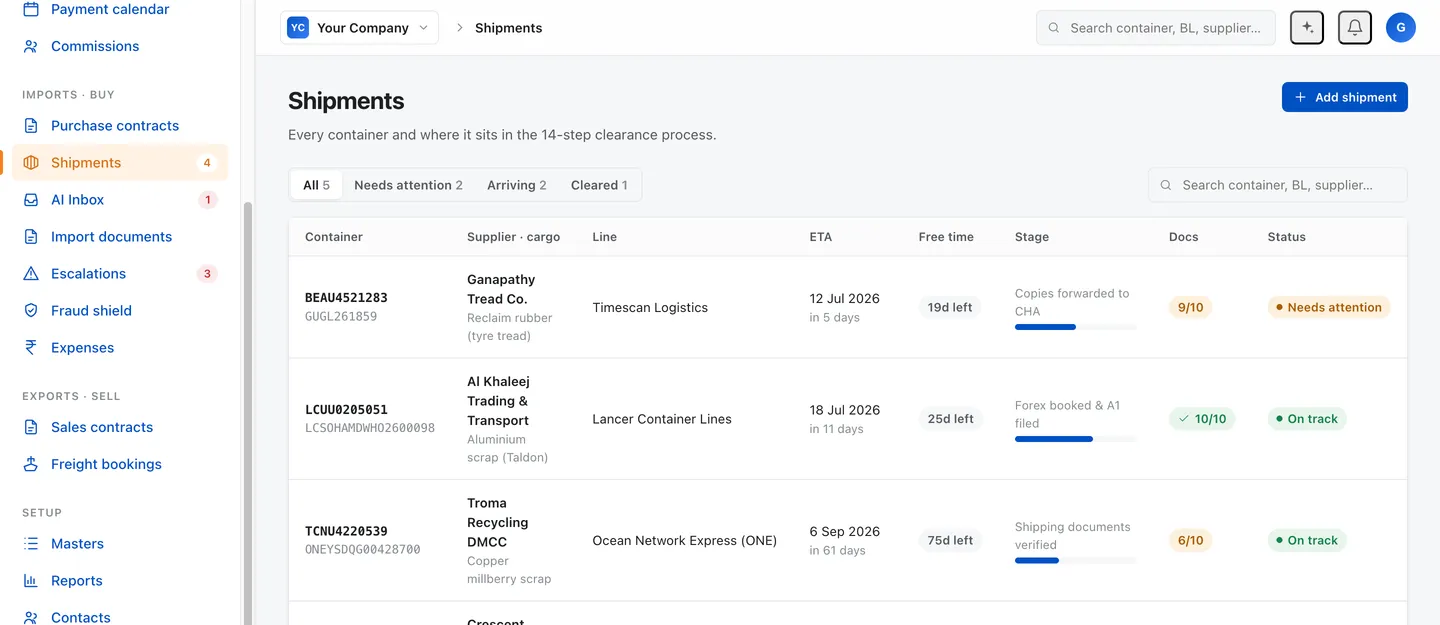
Container availability date: when the demurrage clock starts
The container availability date is the date a discharged import container can in fact be retrieved: released by the terminal, cleared by customs, and not under a hold. It is the day the demurrage clock is supposed to start, it can be later than the discharge date, and in US trade a demurrage or detention invoice that omits it eliminates the obligation to pay the charge.
- Container availability date
- The date on which a discharged import container is actually available to be collected — off the vessel, released by the terminal and free of holds. It is the event free time is meant to run from, and in US trade it is required minimum information on a demurrage or detention invoice.
Two dates sit at the front of every import container’s file, and a desk that treats them as one pays for the difference.
Discharge is an event. Availability is a state.
Discharge is a crane lifting a box off a ship, and it produces a timestamp nobody disputes. Availability is a condition that has to be true of four separate things at once: the container is grounded somewhere a truck can reach, the terminal has released it, customs is not holding it, and the carrier has not put a freight or documentation hold on it.
On a good day they are hours apart. On a bad one they are days apart, and none of the reasons are yours: a yard block that is not worked over the weekend, a vessel discharged out of rotation, a line hold left on for an unpaid invoice that was paid.
Why the date has teeth
Most published tariffs count free time from discharge, because discharge is a fact the terminal already owns. That is a tariff term and it is enforceable, but it is not the same thing as the charge being reasonable.
The US Federal Maritime Commission’s interpretive rule says it may consider, in assessing whether a demurrage practice is unjust or unreasonable:
the extent to which demurrage practices and regulations relate demurrage or free time to cargo availability for retrieval
and, in the paragraph after next, “whether and how regulated entities provide notice to cargo interests that cargo is available for retrieval”. Both are about the same gap. Free time that ran while the container could not be collected is the argument those two paragraphs are there to support, and the evidence for it is a pair of timestamps.
It is a required field on a US invoice
For imports, 46 CFR § 541.6 makes the container availability date part of the required minimum information on a demurrage or detention invoice, next to the allowed free time in days and the start and end dates of free time. Section 541.5 states the consequence in one sentence:
Failure to include any of the required minimum information in this part in a demurrage or detention invoice eliminates any obligation of the billed party to pay the applicable charge.
That makes the availability date the first thing to look for on a US demurrage invoice, and the first thing to ask for anywhere else, because a carrier that will not state in writing which day it started counting from is a carrier whose arithmetic you cannot check. The demurrage invoice entry walks the rest of the fields, and the post on how to calculate demurrage charges does the sum the fields are supposed to let you reproduce.
What a desk does about it
Record the availability timestamp from the terminal, not from the carrier’s tracking page, on the day it appears. It is the number your last free day is derived from, it is the number a dispute turns on later, and it is unrecoverable once the terminal’s portal has moved on.
Then work backwards from it rather than forwards from the arrival notice. Document packs routinely run about eight days late against free time, and a week of demurrage on one container has cost US$12,000 — so the useful question on the day a box becomes available is not how many free days are left, but which document in the pack is still missing and who has not answered about it. That is what demurrage and detention software should be doing with the date, rather than displaying a countdown.
Questions traders ask
What is the container availability date?
The date the box is yours to collect: discharged from the vessel, released by the terminal, and not sitting under a customs, carrier or line hold. It is the event the demurrage clock is meant to run from, which is why a demurrage invoice in US trade has to print it.
Is the container availability date the same as the discharge date?
Not necessarily, and the gap is where the argument is. Discharge is a crane movement. Availability is a state — the container has been grounded in a position you can reach, the terminal has released it, and no hold is on it. A box discharged on Friday evening into a yard block that is not worked until Monday was discharged on Friday and available on Monday. Many published tariffs count from discharge anyway; that is a tariff term, not a definition of availability.
Does the carrier have to tell me the container availability date?
In US trade, yes. Section 541.6 of title 46 of the Code of Federal Regulations makes the container availability date required minimum information on every import demurrage or detention invoice, alongside the allowed free time in days and the start and end dates of free time. Section 541.5 supplies the consequence: leaving out any required field eliminates any obligation of the billed party to pay the charge. Outside US trade nothing compels it, and you should ask for it in writing anyway.
Why does the availability date matter if my tariff counts from discharge?
Because it is the basis on which an unreasonable charge is argued. The Federal Maritime Commission says it may consider, in assessing reasonableness, "the extent to which demurrage practices and regulations relate demurrage or free time to cargo availability for retrieval", and separately whether and how you were given notice that the cargo was available. Free time that ran while the box could not be collected is the case you make with those two paragraphs.
Where do I find the availability date?
The terminal's own system is the authority, not the carrier's tracking page: terminal appointment portals publish an availability or released status per container, and that timestamp is what your transporter books against. The arrival notice tells you the vessel arrived; it does not tell you the box is reachable. Keep both, with their timestamps, because a demurrage dispute turns on the difference between them.
Sources
- 46 CFR § 541.6(b)(6), Contents of invoice — for imports, a demurrage or detention invoice must include the container availability date, along with the invoice date, the invoice due date, the allowed free time in days, the start date of free time, the end date of free time and the specific date(s) charged · checked 2026-09-28
- 46 CFR § 541.5, Failure to include required information — "Failure to include any of the required minimum information in this part in a demurrage or detention invoice eliminates any obligation of the billed party to pay the applicable charge." · checked 2026-09-28
- 46 CFR § 545.5(c)(2)(i) and (iii), Particular applications of the incentive principle — the Commission may consider "the extent to which demurrage practices and regulations relate demurrage or free time to cargo availability for retrieval", and "whether and how regulated entities provide notice to cargo interests that cargo is available for retrieval" · checked 2026-09-28
- Docket operational baseline, import–export desk