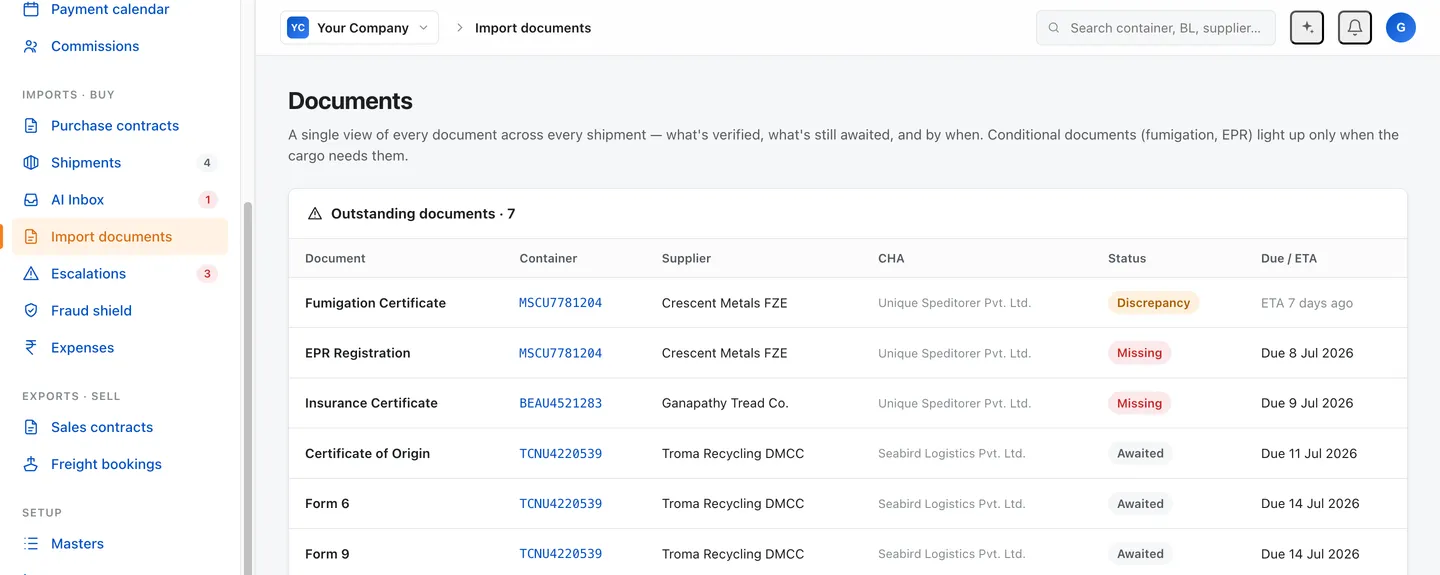
Delivery order: the document that releases your container
A delivery order is the written instruction from the carrier or its agent telling the terminal to hand a named container to a named party. It is not a bill of lading and not a customs document. It issues once the originals are surrendered or a telex release is in, and the freight and local charges are paid. Until it does, the container is at the terminal and free time is still running.
- Delivery Order
- A written instruction from an ocean carrier or its agent to the terminal, authorising release of specified containers to a named party. Issued once title documents are surrendered or released electronically and the carrier's charges are settled, and required before the container can gate out.
A delivery order is the piece of paper that turns a container you own into a container you can collect.
It is a written instruction from the carrier, or its local agent, to whoever is holding the box: release these containers to this party. The terminal acts on the carrier’s instruction. It does not act on yours, and it does not act on the fact that your file is complete.
That is the whole reason this document deserves an entry. On most desks it is not tracked, because it is not a document anyone produces or checks. It is a permission somebody else grants, and the day it arrives is the day the shipment actually becomes yours to move.
What it is not
Two confusions, both expensive.
It is not the bill of lading. The bill of lading is the contract of carriage and the document of title. It establishes who is entitled to the goods. The delivery order is issued afterwards, by the carrier, once the carrier is satisfied of that entitlement and of its own money. The bill is the right; the order is permission to exercise it.
It is not a customs document. Customs clearance and carrier release are two separate gates on two separate authorities, and passing one tells you nothing about the other. A consignment can be assessed, duty-paid and cleared, and still be sitting in the terminal because the release has not come. It can equally be released by the carrier and stuck on a customs query. Both gates have to be open on the same day for the box to gate out, and nobody coordinates that for you.
What has to be true before it issues
The delivery order is the last link of a chain, and every earlier link is somebody else’s.
- Title documents settled. The original bills of lading surrendered to the carrier, or a telex release sent by the shipper at origin, which the shipper generally will not send until it has been paid, or until its bank tells it to.
- The carrier’s money in. Freight where it is payable at destination, plus the local charges: terminal handling, documentation, the delivery order fee itself.
- The paperwork the carrier itself asks for, which varies by carrier and by lane, and which nobody discovers is missing until it is asked for.
Read that list as a sequence of inboxes. A bank’s courier. A shipper’s accounts department. An agent’s counter. Not one of them is looking at your free time, and no step in the chain generates a warning when it stalls.
The clock does not wait for the release
This is the part that turns an administrative step into a number on an invoice.
Free time runs from discharge. The delivery order is a step that happens inside free time, not an extension of it, so every day spent waiting for the release is a day spent out of the allowance. The last free day is fixed the moment the box comes off the vessel, whether or not anyone has yet asked the shipper for a telex release.
Document packs routinely run about eight days late against free time, and a week of demurrage on one container has cost about US$12,000. A release stuck behind an unpaid local charge is one of the ordinary ways those eight days get spent.
Waiting for a release you could not obtain, and what that is worth
In US trade there is something to say about this at the dispute stage, and it is stronger than most importers realise they hold.
The Federal Maritime Commission’s interpretive rule on demurrage and detention sets out what the Commission may weigh when it assesses whether a practice is unjust or unreasonable. Among the particular applications of its incentive principle:
Cargo availability. The Commission may consider in the reasonableness analysis the extent to which demurrage practices and regulations relate demurrage or free time to cargo availability for retrieval.
And, separately:
Notice of cargo availability. In assessing the reasonableness of demurrage practices and regulations, the Commission may consider whether and how regulated entities provide notice to cargo interests that cargo is available for retrieval.
Note what that is and is not. It is an interpretive rule about how the Commission analyses reasonableness, not a rule that voids a charge. But it points at the right question: could this cargo actually have been retrieved on the days it was charged for? Cargo sitting behind an unissued release was not available to the party being billed for it.
Two other provisions sharpen the same point. A US import demurrage or detention invoice must state the container availability date as required minimum information, so the billing party has to commit in writing to the date from which the box could be collected. And the invoice must carry the billing party’s certification that its own performance did not cause or contribute to the charge. A carrier that had not released the container is certifying something worth testing.
Outside US trade there is no equivalent framework, and the argument is a commercial one against your own carrier, made better by having the dates. Which is the practical lesson either way: the value is in the record. If you cannot show when you asked for the release, what you were told, and when it came, there is nothing to dispute with.
The fee is a landed-cost line, not a filing
The delivery order fee is one of the destination charges that arrive after everyone has stopped thinking about the shipment. It belongs on what the container actually cost, with the invoice it came on attached, not in a folder to be reconciled at month end when nobody remembers which box it was for.
It is also a fair yardstick for what running a desk should cost. On many lanes the delivery order fee on a single container is more than what a whole shipment costs to put through Docket.
Where Docket sits
Docket cannot issue your release; only the carrier can. What it can do is stop the release being the step nobody was watching.
From the purchase contract it knows the lane, the carrier and whether the shipment is on a house bill, so it knows which releases have to happen and in what order. It puts each precondition on the calendar counted back from the last free day rather than forward from the arrival notice: when the originals have to be couriered, when the telex release has to be requested, when the local charges have to be settled to leave the terminal a working day to act. Then it chases the party who owes each one — email first, WhatsApp at 24 hours, SMS at 48, an AI voice call at 72 — on channels they already use, with no portal for anyone to sign up for.
And it keeps the record: who was asked, when, and what they said. That is what demurrage and detention software should mean on this step, and it is a different job from displaying a container’s status. You can put your own free days and per-diem tiers into the demurrage calculator to see what a week of waiting for a release is worth.
Questions traders ask
What is a delivery order in shipping?
It is the carrier's written instruction to whoever is holding your container, telling them to release it to you or to your transporter. The terminal takes its instruction from the carrier, not from you, which is why the box does not move on your say-so however complete your own paperwork is. The delivery order is the moment the carrier stops being in the way.
Is a delivery order the same as a bill of lading?
No, and the difference matters. The bill of lading is the contract of carriage and the document of title: it says who is entitled to the goods. The delivery order is an instruction issued off the back of it, once the carrier is satisfied that entitlement is proved and its own charges are paid. One is the right, the other is permission to act on it. You surrender the first to get the second.
How long does a delivery order take to issue?
That is the wrong question to plan against, because the delay is almost never the issuing. It is the queue behind it: originals still in a bank's courier, a telex release the shipper has not asked for, freight or local charges unpaid, a document the carrier is waiting on. Each of those is somebody else's inbox, and none of them pauses free time.
What is a delivery order fee?
A charge the carrier or its agent raises for issuing the release, usually alongside other local charges at destination. It is one of the lines that decides what a container really cost, which is why it belongs on the landed cost rather than in a folder. It is also a useful yardstick: on many lanes the delivery order fee on a single box is larger than what a whole shipment costs to run through Docket.
Can I be charged demurrage while waiting for the delivery order?
The clock does not stop for it, and the charge will be raised. Whether it survives being disputed is a different question and depends on the jurisdiction. In US trade the Federal Maritime Commission's interpretive rule says it may consider, in assessing whether a demurrage practice is unreasonable, the extent to which the practice relates free time to cargo availability for retrieval, and whether and how the party charging gave notice that cargo was available. A billing party also has to certify on the invoice that its own performance did not cause or contribute to the charge. A container that could not be collected because the carrier had not released it is worth arguing about on those grounds.
Who issues the delivery order?
The ocean carrier or its local agent, for the container. Where a freight forwarder issued its own house bill of lading, the forwarder issues the release to you and takes the carrier's release for itself, so there are two releases in sequence and the second one is invisible to you until it is late. Ask which structure your shipment is on before the vessel arrives, not after.
Sources
- 46 CFR § 545.5, Interpretation of Shipping Act of 1984 — Unjust and unreasonable practices with respect to demurrage and detention: § 545.5(c)(2)(i) cargo availability, (ii) empty container return, (iii) notice of cargo availability [85 FR 29665, May 18, 2020] · checked 2026-09-10
- 46 CFR § 541.6, Contents of invoice: § 541.6(b)(6) makes the container availability date required minimum information on a US import demurrage or detention invoice, and § 541.6(e)(2) requires the billing party to certify that its own performance did not cause or contribute to the invoiced charge [89 FR 14363, Feb. 26, 2024] · checked 2026-09-10
- Docket operational baseline, import–export desk · checked 2026-09-10