Detention certificate meaning, and what it actually waives
A detention certificate is Customs certifying the period for which imported goods were seized or detained by the department. Under regulation 6(1)(l) of the Handling of Cargo in Customs Areas Regulations 2009 the custodian (port, CFS or ICD) shall not charge rent or demurrage for that period, and the Supreme Court applied it against a port trust in 2017. It covers days Customs took, not yours.
- Detention Certificate
- A certificate issued by Customs recording the period for which imported goods were seized, detained or held by the department, used to obtain waiver of the custodian's rent and demurrage for that period under regulation 6(1)(l) of the Handling of Cargo in Customs Areas Regulations, 2009.
A detention certificate is Customs writing down the dates. It says that between one day and another, this consignment was in the department’s hands: seized, detained for examination, held pending a test report, held while a licence question was argued. Those days are not the importer’s fault, and the law says the custodian of the customs area cannot bill for them.
That is the whole mechanism, and it is narrower than most people assume.
What the regulation actually says
The Handling of Cargo in Customs Areas Regulations, 2009 are made under section 141(2) of the Customs Act, 1962 and govern anyone approved to handle imported or export goods in a customs area: a port terminal, a container freight station, an inland container depot. The regulations call such a party a Customs Cargo Service Provider.
Regulation 6(1)(l) obliges that provider not to charge any rent or demurrage on goods seized, detained or confiscated by the customs officers the regulation names.
Two things follow from the wording. It bites on the custodian, because the custodian is who the regulation is addressed to. And it bites on a period defined by what Customs did, not by what the importer wishes had happened faster.
The Supreme Court applied it in 2017
In Mumbai Port Trust v. M/s Shri Lakshmi Steels, decided on 27 July 2017, the goods had been detained at the instance of the Directorate of Revenue Intelligence and the High Court had found that detention illegal. On the demurrage question the Supreme Court held that the port trust was not entitled to charge demurrage, in view of regulation 6(1) of the 2009 regulations, because Customs had issued a detention certificate.
That is the case an importer’s counsel reaches for. It is worth reading the scope of it honestly: the holding is about the custodian’s charge, for a period Customs certified.
Who it binds, and who it does not
This is the distinction that decides whether the certificate saves you money.
| Charge | Whose it is | What the certificate does |
|---|---|---|
| Rent and demurrage in the customs area | The custodian (port, CFS, ICD) | Regulation 6(1)(l) bars the charge for the certified period |
| Container detention | The shipping line, for its own equipment | A separate contract under the bill of lading and the line’s tariff. Lines are commonly asked and often agree; the statutory bar the courts have enforced is the custodian’s |
| Storage after the certified period ends | The custodian | Nothing. The clock restarts |
An importer who wins a waiver from the CFS and assumes the line will follow is going to be surprised by an invoice. Ask both, in writing, and expect the two answers to arrive separately.
What it will not do for you
It will not cover a late document pack. If the Bill of Entry could not be filed because the supplier’s invoice disagreed with the packing list, or the original Bill of Lading was still in a courier bag, those days belong to you. Customs did not hold the goods. Nobody held them. They simply sat.
That is the uncomfortable part of this entry, and it is the reason it exists on this site. On an import desk, free time runs from discharge and the paperwork routinely lands about eight days behind it. None of those eight days is certifiable. A detention certificate is a remedy for the days someone else took, and most of the days are not those.
Getting one
Your customs house agent files the request with the formation that held the consignment, asking for a certificate of the detention period addressed to the custodian. Ask while the file is still open. You are asking an officer to certify dates, and dates get harder to establish once the consignment has gone and the officer has moved on. Then present it to the custodian, and separately to the line, and keep both replies.
Where Docket sits
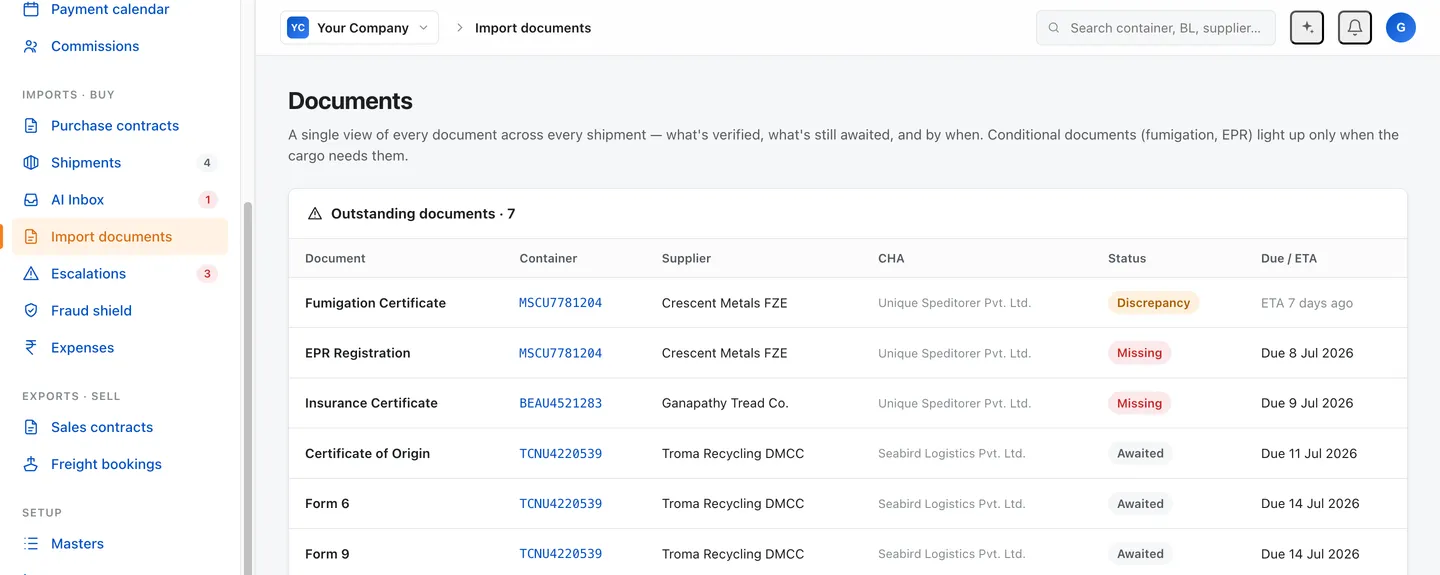
Docket does not obtain detention certificates and does not argue with a custodian. What it holds is the timeline the argument runs on: every document with the date it arrived and who sent it, every chase, every reply. When a bill lands you can see which day the pack was complete and which party sat on which paper, which is the difference between a waiver request that names dates and one that asks for sympathy.
The larger point is the one above. The certifiable delay is the small half. The rest is the paperwork clock, and that one is worked before the bill exists, not after — which is what detention and demurrage software is for.
Questions traders ask
What is a detention certificate in customs?
A document issued by Customs certifying the dates between which a consignment was seized, detained or otherwise held by the department. It is not a waiver in itself; it is the evidence of the period, which regulation 6(1)(l) of the Handling of Cargo in Customs Areas Regulations 2009 then bars the custodian from charging rent or demurrage on.
Does a detention certificate cancel a shipping line's detention charge?
Not automatically, and this is where importers most often get caught. Regulation 6(1)(l) is addressed to the custodian of the customs area: the port trust, CFS or ICD. The carrier's container detention is a charge for its own equipment under the bill of lading and the line's tariff, a different contract with a different party. Lines are routinely asked to honour a detention certificate and often do, but the statutory obligation the courts have enforced is the custodian's.
Can I get a detention certificate because my documents were late?
No. The certificate records days Customs held the goods. Days lost because a supplier had not sent the Bill of Lading, or an invoice disagreed with the packing list, are yours, and no certificate covers them. On an ordinary import desk that is where most of the delay sits.
How do I apply for a detention certificate?
Through your customs broker, to the officer or formation that held the consignment (the appraising group, SIIB or DRI, depending on who detained it), asking for a certificate of the detention period addressed to the custodian. Apply as soon as the goods are released rather than when the custodian's bill arrives; you are asking an officer to certify dates, and the dates are easiest to establish while the file is still open.
Sources
- Handling of Cargo in Customs Areas Regulations, 2009, regulation 6(1)(l): a Customs Cargo Service Provider shall not charge rent or demurrage on goods seized, detained or confiscated · checked 2026-09-07
- Mumbai Port Trust v. M/s Shri Lakshmi Steels and Ors., Supreme Court of India, 27 July 2017: port trust not entitled to demurrage where Customs had issued a detention certificate · checked 2026-09-07
- Customs Act, 1962, section 141(2), under which the 2009 regulations are made
- Docket operational baseline, import–export desk