Seal number: the field that is allowed to change
A seal number identifies the security seal closing a container's doors, and it is a required field on the US inward Cargo Declaration under 19 CFR 4.7a(c)(4)(xiv). Unlike the container number it can legitimately change in transit: 19 CFR 18.4(c) lets a responsible agent of the carrier remove seals for casualty or other good reason, and requires updated seal numbers to be transmitted to CBP.
- Seal number
- The identifier on the security seal fitted to a loaded container's doors, recorded on the bill of lading, the packing list and the carrier's manifest. It evidences that the doors were not opened between stuffing and delivery, and US rules require the number on the Cargo Declaration.
A seal number is the number on the security seal fitted through the locking bar of a loaded container’s doors. It is recorded when the box is stuffed and then copied onto the paperwork, and its job is narrow: to let whoever opens the container say whether the doors were opened on the way.
It is the one field on an import document pack that is allowed to be different at the other end. That is the thing to know about it, and almost nothing written for importers says so.
What US law does with it
Two provisions, and they pull in opposite directions in a way that is useful rather than contradictory.
The arrival filing has to carry it. 19 CFR 4.7a(c)(4)(xiv) lists “The seal numbers for all seals affixed to containers” among the elements the carrier files on the Cargo Declaration, alongside the container number at (c)(4)(xiii). The plural is in the regulation twice: all seals, all containers.
And the seal is allowed to come off. 19 CFR 18.4(a)(1) sets the baseline, that seals “remain intact until the merchandise arrives at the port of destination or the port of exportation”. Then 18.4(c) names the exceptions: where it becomes necessary in transit, “a responsible agent of the carrier may remove the seals”, including “because of casualty or for other good reason” and “when required by law enforcement or another government agency”, and the agent may reseal afterwards. The sentence that follows is the one a desk needs: “Updated seal numbers must be transmitted to CBP pursuant to § 18.1(h).”
Why that changes the checking rule
A document check that flags every seal-number mismatch as an error is wrong, and a check that ignores them is worse. The two cases look identical on the paperwork and they are not the same thing.
- The seal was lawfully replaced, and an updated number was transmitted. The file is complete; what is missing is the update on your copy.
- The seal was replaced, broken or never fitted, and nothing was transmitted. Now the only evidence that the declared cargo is the cargo that travelled has gone.
So the question to ask is never “do the numbers match”. It is “if they differ, is there a transmitted update that accounts for it”. That is one phone call at the time and an unanswerable argument six weeks later.
Why it matters more than it looks
Because of what a seal does to every other document. 19 CFR 4.7a(c)(4)(vii) requires, for a sealed container, “the shipper’s declared description and weight of the cargo”. Nobody between the stuffing and the delivery opened the box, so nobody in between can describe what is in it from their own knowledge. The whole carrier-side record of your consignment rests on what the supplier wrote down, and the seal number is the only field on the file that says the box was not touched after they wrote it.
That also makes it the earliest field you cannot verify yourself. It is set at the far end, by the party you are already chasing for the packing list and the invoice, and it reaches you on their paperwork or not at all.
What Docket does with it
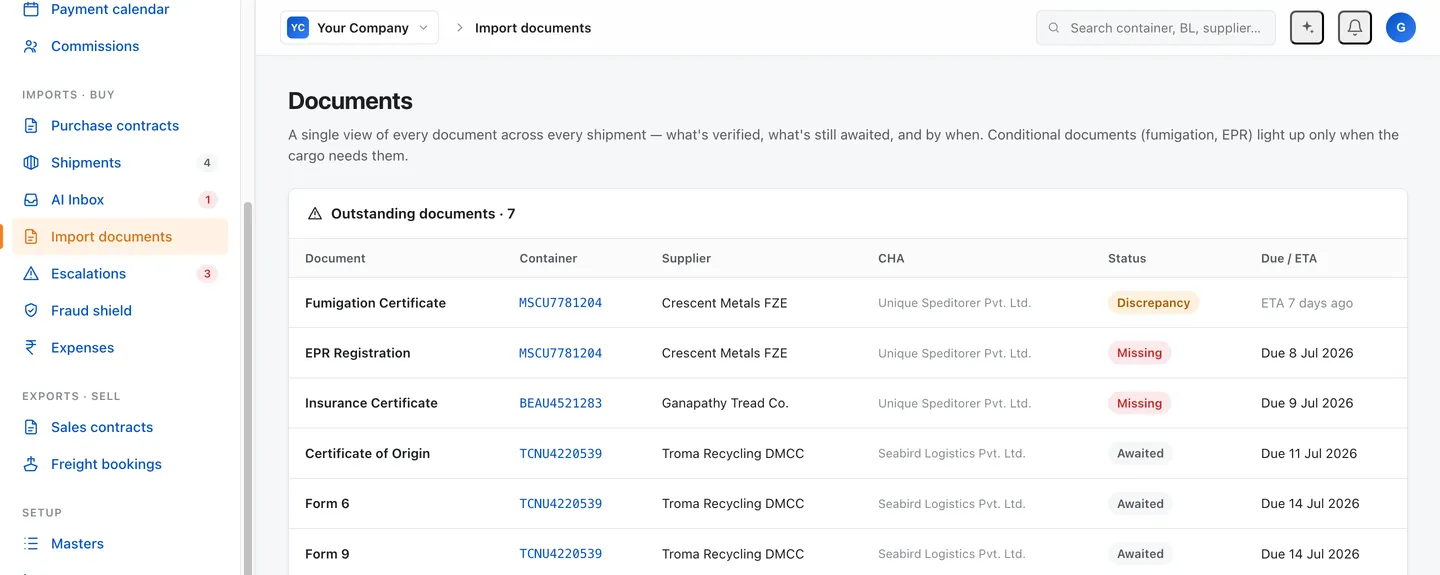
It reads the seal numbers off every document in the pack and compares them, the same way it compares container numbers, and it treats a difference as a question rather than a verdict: which document says what, on what date, and is there a reseal in the record. The point is not to catch the supplier out. It is that the answer takes a minute while the box is still on the water and takes a week once it has landed, and a container waiting for an answer is a container on somebody’s storage clock. Document packs routinely run about eight days late against free time, and a week of demurrage on one container has cost US$12,000.
Questions traders ask
What is a seal number?
The number marked on the security seal fitted through the locking bar of a loaded container's doors. It is recorded when the box is stuffed and then carried on the paperwork, so that whoever opens the container at the other end can say whether the doors were opened on the way. The number identifies the seal, not the box: the container number stays with the container for its working life, while the seal is a one-use fitting and its number changes every time the box is stuffed.
Is the seal number a required field?
On the US inward Cargo Declaration, yes. 19 CFR 4.7a(c)(4)(xiv) lists "The seal numbers for all seals affixed to containers" among the required elements the carrier files on arrival. Note the plural in two places: all seals, and all containers. A consignment of several boxes carries several seal numbers and every one of them has to be on the filing.
Why do the seal numbers on my documents not match?
Because a seal is allowed to change, and this is the part most desks do not know. 19 CFR 18.4(c) provides that where it becomes necessary in transit, "a responsible agent of the carrier may remove the seals" for reasons including "because of casualty or for other good reason" such as "when required by law enforcement or another government agency", and may then reseal the container. The same paragraph says what has to happen next: "Updated seal numbers must be transmitted to CBP pursuant to § 18.1(h)." So a mismatch between the number on the packing list and the number on arrival can be lawful. What makes it a problem is the absence of an updated number in the record.
What should I do if a container arrives with a broken or missing seal?
Treat it as a condition to record rather than a conclusion. Photograph the doors and the seal remains before anything is moved, note the number actually present against the number the documents carry, and ask the carrier for the transmitted seal update. 19 CFR 18.4 covers planned removal and the transmission that follows it; it does not say what happens when a seal is simply found broken, which is why the carrier's own record of what it transmitted is the document that settles it.
Why does the manifest describe my cargo on the shipper's word?
Because of the seal. 19 CFR 4.7a(c)(4)(vii) requires, "for a sealed container, the shipper's declared description and weight of the cargo". Nobody in the chain opened the box, so nobody downstream can describe the contents from their own knowledge. That is the whole reason the seal number matters to an importer: it is the only evidence on the file that what the shipper declared is what travelled.
Who fits the seal?
On a normal full-container export, whoever stuffed the box, which is usually the supplier or the consolidator and not the carrier. That is also why the seal number is the earliest field on the pack that you cannot verify yourself: it is recorded at the far end, by the party you are chasing for documents, and it arrives on their paperwork.
Can customs break the seal?
Yes, and the rules assume it. 19 CFR 18.4(c) names a removal "required by law enforcement or another government agency" among the good reasons, and a container pulled for examination is opened and resealed as a matter of course. The examination is also what costs an importer money: free time keeps running while the box sits waiting for one, and the new seal number is one more field that has to find its way back onto the file.
Sources
- 19 CFR 4.7a, Inward manifest; information required (US Customs and Border Protection) — § 4.7a(c)(4)(xiv), "The seal numbers for all seals affixed to containers", among the elements required on the Cargo Declaration, CBP Form 1302; and § 4.7a(c)(4)(vii), which requires "for a sealed container, the shipper's declared description and weight of the cargo" · checked 2026-10-31
- 19 CFR 18.4, Sealing of conveyances, compartments, and containers (US Customs and Border Protection) — § 18.4(a)(1), seals must "remain intact until the merchandise arrives at the port of destination or the port of exportation"; § 18.4(c), where it becomes necessary in transit "a responsible agent of the carrier may remove the seals", including "because of casualty or for other good reason" and "when required by law enforcement or another government agency", after which "Updated seal numbers must be transmitted to CBP pursuant to § 18.1(h)" · checked 2026-10-31