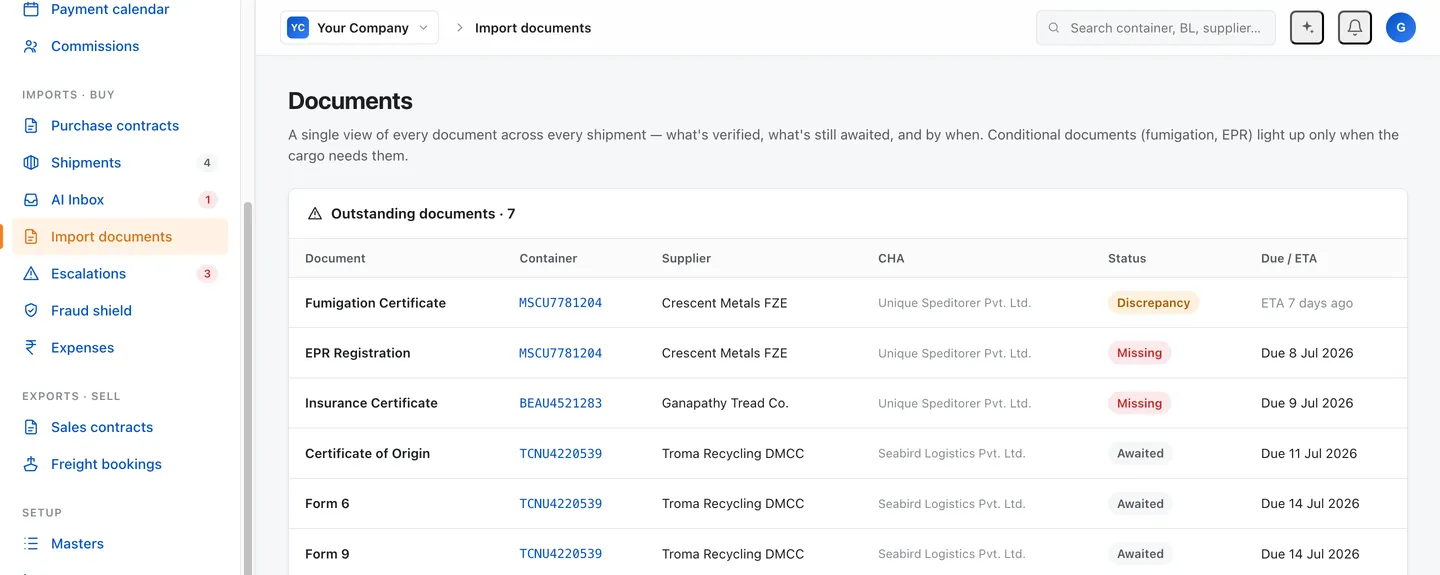
Container number: the one field that checks itself
A container number is the identifier marked on a shipping container: three letters for the owner, one for the equipment category, a six-digit serial, and a check digit whose job is to prove the other ten were recorded correctly. US law requires it twice on one shipment: on the inward Cargo Declaration under 19 CFR 4.7a(c)(4)(xiii) and on a demurrage invoice under 46 CFR 541.6(a)(2).
- Container number
- The eleven-character identifier marked on a shipping container: a three-letter owner prefix, a one-letter equipment category identifier, a six-digit serial number and a single check digit that validates the other ten. It is the identifier that follows one box across every party's paperwork.
A container number is the thing painted on the end of the box, and it is the only identifier on an import document pack that can be proved right or wrong on its own. Everything else on the pack has to be checked against somebody: the invoice against the contract, the weight against the packing list, the bill of lading number against whatever the carrier sent. The container number carries its own test.
That is what the last digit is. The Bureau International des Containers, which issues the three-letter owner prefixes, describes the check digit as “providing a means of validating the recording and transmission accuracies of the owner code and serial number”. It is not part of the box’s identity. It is arithmetic about the other ten characters, and it exists because this number gets retyped by hand at every party in the chain.
What the eleven characters are
Read from the left, the number tells you who owns the box before it tells you which box it is. BIC gives the parts as an owner prefix of “three capital letters of the Latin alphabet to indicate the owner or principal operator of the container”, then an equipment category identifier of one letter, then a serial number of “six Arabic numerals, left at owner’s or operator’s option”, then the check digit.
The category letter is the one people skip. BIC lists three values: “U for all freight containers”, “J for detachable freight container-related equipment”, and “Z for trailers and chassis”. On a US detention invoice that distinction has money in it, because the chassis under the container is separate equipment and can carry its own charge. If you are reading a charge and the identifier starts with a Z, you are not being billed for the box.
Where US law requires it, twice
The same eleven characters are a required field at both ends of the clock, under two different regimes, and neither one knows about the other.
At the arrival end, the carrier’s Cargo Declaration has to name it. 19 CFR 4.7a(c)(4)(xiii) lists “Container numbers (for containerized shipments)” among the required elements, and 4.7a(c)(2)(i) says exactly where it belongs: column 6, against each covering bill of lading, “The number of the container which contains the cargo covered by that bill of lading”. Where a carrier uses the separate-list alternative instead, 4.7a(c)(2)(ii)(A) requires that “Each container number shall be listed in alphanumeric sequence by port of discharge”.
At the charge end, the Federal Maritime Commission’s billing rule lists “The container number(s)” among the identifying information a demurrage invoice must contain, at 46 CFR 541.6(a)(2). The same part states what happens if a required field is missing, at 46 CFR 541.5: failure to include any of the required minimum information “eliminates any obligation of the billed party to pay the applicable charge”.
So the first line to read on a charge is not the rate. It is whether the box named on the invoice is your box, and whether it is named at all.
Why it is the field that goes wrong
Because it is eleven characters with no meaning in them, and it is transcribed by hand more often than anything else on the pack. It arrives on a booking confirmation, gets retyped onto a packing list, read off a photograph of the door, keyed into a customs declaration by a customs broker in another country, and printed on an invoice weeks later by a party that never saw the box. Each hop is a chance for two digits to swap.
A wrong container number does not announce itself. It produces a document pack that looks complete and refers to a box that is not yours, and the failure surfaces at the worst possible moment: at the gate, or on a charge you cannot match to anything you imported. The check digit is the cheap defence, and almost nobody uses it, because checking it by hand for every box on every document is the first work a desk drops.
What Docket does with it
This is job one of the six, document completeness and correctness checking, in its most literal form. Docket reads the container numbers off every document in the pack, tests the check digit on each, and compares them across documents, so a number that is internally valid but disagrees between the packing list and the declaration is still caught. The rule it enforces is the boring one: the same box has to be the same eleven characters everywhere, and a charge for a box that is not in the file is a charge to dispute before it is a charge to pay.
Packs routinely run about eight days late against free time, and a week of demurrage on one container has cost US$12,000. A mistyped identifier is a small reason to join that statistic, which is the argument for having a machine read it rather than a person. Demurrage and detention software that cannot tell you which boxes on an invoice are yours is checking the arithmetic and not the claim.
Questions traders ask
What is a container number?
The identifier marked on the container itself, eleven characters long. The Bureau International des Containers, which issues the owner prefixes, describes the parts as an owner prefix of "three capital letters of the Latin alphabet to indicate the owner or principal operator of the container", an equipment category identifier, a serial number of "six Arabic numerals, left at owner's or operator's option", and a check digit. It identifies the box, not the cargo and not the shipment: one bill of lading can cover several container numbers, and the same box carries the same number on its next voyage for somebody else.
What does the U mean in a container number?
It is the equipment category identifier, the single letter after the owner prefix, and it says what kind of equipment the number belongs to. BIC gives three values: "U for all freight containers", "J for detachable freight container-related equipment" and "Z for trailers and chassis". A number with a U is a box. A number with a Z is a chassis, which matters on a detention invoice, because a chassis and the container riding on it can be billed separately.
What is the check digit in a container number for?
To catch a typing or transmission error before it travels. BIC states its purpose directly: it provides "a means of validating the recording and transmission accuracies of the owner code and serial number". The practical consequence is that a container number is the only identifier on an import document pack that can be tested on its own, without ringing anybody up. A bill of lading number cannot be checked arithmetically, and neither can an invoice number. BIC publishes a check-digit calculator for the test.
Is the container number required on a demurrage invoice?
Yes, in US trade. The Federal Maritime Commission's billing rule lists "The container number(s)" among the identifying information a demurrage or detention invoice must contain, at 46 CFR 541.6(a)(2). The effect of leaving a required field out is stated in the same part, at 46 CFR 541.5: failure to include any of the required minimum information "eliminates any obligation of the billed party to pay the applicable charge". So the first thing to read on a demurrage invoice is whether your box is actually named on it.
Where else does the container number have to appear?
On the inward Cargo Declaration that the carrier files on arrival in the United States. 19 CFR 4.7a(c)(4)(xiii) lists "Container numbers (for containerized shipments)" among the required elements, and 19 CFR 4.7a(c)(2)(i) says where it goes: column 6 against each covering bill of lading, "The number of the container which contains the cargo covered by that bill of lading". The same eleven characters therefore appear on the customs filing at the start of the clock and on the charge invoice at the end of it.
What is the difference between a container number and a BIC code?
The BIC code is the first three letters, not the whole number. It identifies the owner or principal operator, and it is issued rather than chosen. The remaining eight characters, the equipment category letter, the six-digit serial and the check digit, belong to the container. Reading a container number from the left tells you who owns the box before it tells you which box it is.
Can two containers have the same number?
Not at the same time, which is the point of issuing the owner prefix centrally rather than letting each operator pick its own. What does happen is reuse over time and transfer between operators, so a container number is a reliable key for one shipment and an unreliable one for a history. Any system that treats the number as a permanent primary key will eventually join two different voyages into one.
Sources
- Bureau International des Containers, container identification number — the four parts of the number: an owner prefix of "three capital letters of the Latin alphabet to indicate the owner or principal operator of the container"; an equipment category identifier, "U for all freight containers", "J for detachable freight container-related equipment", "Z for trailers and chassis"; a serial number of "six Arabic numerals, left at owner's or operator's option"; and a check digit "providing a means of validating the recording and transmission accuracies of the owner code and serial number". BIC issues the owner prefixes and publishes a check-digit calculator; it does not publish the calculation itself on this page · checked 2026-10-31
- 46 CFR part 541, Demurrage and Detention (US Federal Maritime Commission) — § 541.6(a) Identifying information, which requires among the minimum contents of a demurrage or detention invoice "The Bill of Lading number(s)" and "The container number(s)"; and § 541.5, Failure to include required information: "Failure to include any of the required minimum information in this part in a demurrage or detention invoice eliminates any obligation of the billed party to pay the applicable charge" · checked 2026-10-31
- 19 CFR 4.7a, Inward manifest; information required (US Customs and Border Protection) — § 4.7a(c)(4)(xiii) lists "Container numbers (for containerized shipments)" among the elements required on the Cargo Declaration, CBP Form 1302; § 4.7a(c)(2)(i) places it in column No. 6 against each covering bill of lading, "The number of the container which contains the cargo covered by that bill of lading"; and § 4.7a(c)(2)(ii)(A), on the separate-list alternative, "Each container number shall be listed in alphanumeric sequence by port of discharge" · checked 2026-10-31