Single window: one submission, every agency that needs it
A single window is one entry point through which a trader submits the documents and data for an import, export or transit, and through which every participating authority answers. The WTO Trade Facilitation Agreement puts it at Article 10.4, and the rule a desk can use is 10.4.2: data already received through the single window must not be requested again, bar published exceptions.
- Single window
- A single entry point through which a trader submits the documentation and data required to import, export or tranship goods, and through which the participating authorities return their decisions, so that one submission reaches every agency with a say in the consignment.
What it is
A single window is the arrangement by which a consignment’s paperwork is filed once. The trader or their agent submits the documents and data in one place; the authorities that have a say in the cargo read that submission rather than demanding their own copy; and their decisions come back through the same channel.
The definition worth quoting is the WTO’s, because it is the one every national system is measured against. Article 10.4.1 of the Trade Facilitation Agreement describes a window
enabling traders to submit documentation and/or data requirements for importation, exportation, or transit of goods through a single entry point to the participating authorities or agencies.
and then adds the half that people forget:
After the examination by the participating authorities or agencies of the documentation and/or data, the results shall be notified to the applicants through the single window in a timely manner.
One door in. The same door out.
The rule a desk can use
Most of Article 10.4 is written in the language of encouragement. Members “shall endeavour” to have a window, and shall use information technology “to the extent possible and practicable”. Paragraph 10.4.2 is not. Where documentation or data
have already been received through the single window, the same documentation and/or data requirements shall not be requested by participating authorities or agencies except in urgent circumstances and other limited exceptions which are made public.
Two things follow for an import desk. The first is that a second request for a document you already filed is, as a default, not supposed to happen. The second is more useful: the exceptions have to be made public. So when a request does come, there is a published basis to point at, which turns an argument about whose job it is into a question with an answer.
Why the names differ everywhere
Nobody trades under the WTO’s vocabulary. They trade under their market’s.
Singapore’s single window is TradeNet, and it is the oldest of them; every import, export and transhipment permit application is lodged through it, which is why a declaring agent is the party that touches it rather than the importer. In Dubai, customs declarations go into Mirsal 2 through Dubai Trade and the clearing agent files them; Abu Dhabi’s platform describes itself as the official single window for trade in the emirate. India’s is SWIFT, built on ICEGATE, which is how a Bill of Entry is referred to the food or plant health authority without a separate filing. The United States has ACE and Australia the Integrated Cargo System.
The market-by-market table on the customs broker entry lays the names out beside the filing and the party who does the filing, which is the practical form of the question: on this lane, what is the system called and who has the login?
What it does not fix
A single window is a letterbox improvement. It removes the sequential delay, where a document sits with agency one while agency two waits, and it removes the second request for the same file.
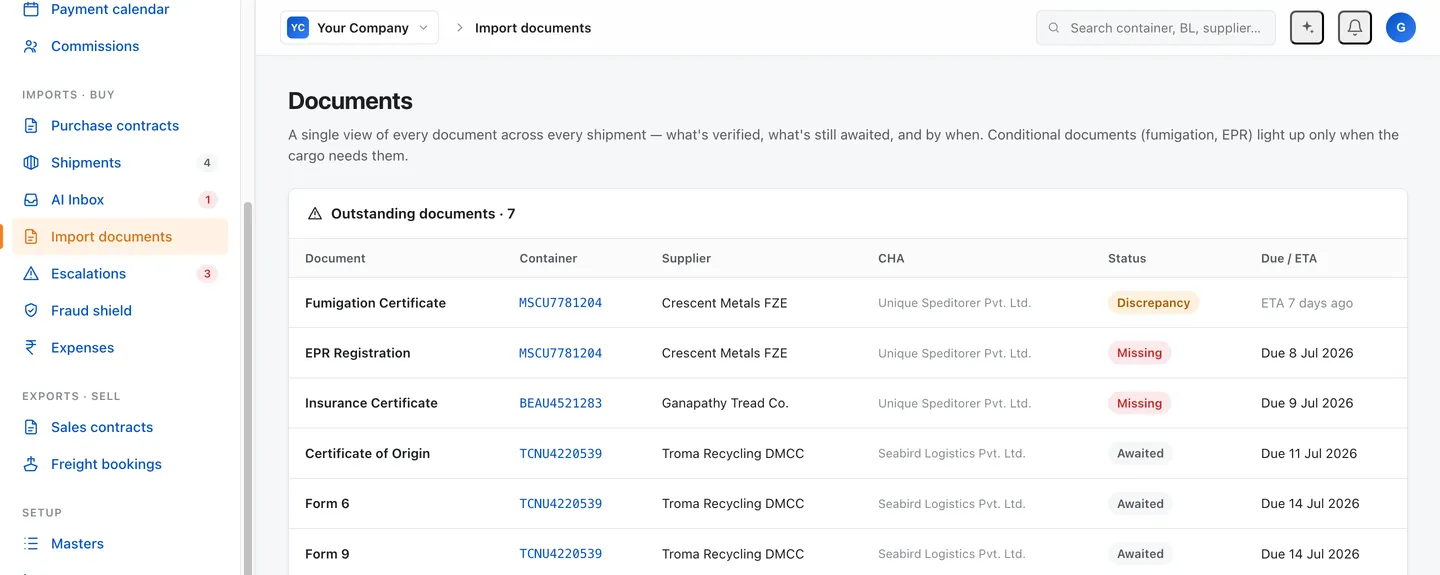
It does nothing about the delay that costs money. A window cannot file a certificate of origin your supplier has not drafted, and it cannot correct a packing list that disagrees with the invoice. On an import, the clock that matters starts at discharge and runs against the pack being complete, which is why free time is spent waiting on counterparties far more often than on agencies. Getting the documents in hand, and correct, before the window ever opens is a different job, and it is the one import document checking software exists to do.
Questions traders ask
What is a single window in trade?
One entry point for a consignment's paperwork. The WTO definition is a window "enabling traders to submit documentation and/or data requirements for importation, exportation, or transit of goods through a single entry point to the participating authorities or agencies". The second half matters as much as the first: after those authorities have examined the submission, "the results shall be notified to the applicants through the single window in a timely manner". One door in, one door out.
Is a single window the same as a customs portal?
No, and the difference is who answers. A customs portal reaches customs. A single window reaches customs and the other agencies with a say in the cargo — the food authority, the plant health authority, the standards body, the controlled-goods licensing authority — off one submission. If your health certificate still has to be filed somewhere else, what you are using is a portal with an ambitious name.
Can an agency ask for a document I already filed through the single window?
Not as a rule. Article 10.4.2 of the WTO Trade Facilitation Agreement states that where documentation or data "have already been received through the single window, the same documentation and/or data requirements shall not be requested by participating authorities or agencies except in urgent circumstances and other limited exceptions which are made public". The exceptions have to be published, which means a second request is checkable rather than a matter of opinion.
What is my market's single window called?
Singapore's is TradeNet, and every permit declaration goes through it. Dubai's customs declarations are lodged in Mirsal 2, reached through Dubai Trade, and Abu Dhabi's platform is the ATLP. India's customs single window is SWIFT, running on ICEGATE, which is how a Bill of Entry reaches the food or plant health authority automatically. The United States has ACE and Australia the Integrated Cargo System. The vocabulary table on the customs broker entry sets the names out market by market.
Is a single window compulsory for a WTO member?
Not in the strong sense. Article 10.4.1 says members "shall endeavour to establish or maintain a single window", which is a best-endeavours obligation rather than a hard one, and 10.4.4 asks them to use information technology "to the extent possible and practicable". What is firmer is the consequence once one exists: the no-second-request rule at 10.4.2, the duty at 10.4.3 to notify the Committee of how the window operates, and therefore a published account of what it covers.
Does a single window shorten clearance?
It removes a particular kind of delay: the sequential one, where a document sits with one agency while a second agency waits for the first. It does nothing about the delays that actually run most demurrage clocks — a document a counterparty has not sent you yet, or one that is wrong. A single window is a better letterbox. Somebody still has to fill the envelope.