Clearing agent: who files your Dubai customs declaration
A clearing agent is what an importer in Dubai calls the party that files its customs declaration. Dubai Customs licenses the role as a customs broker under Customs Policy No. 17 of 2008. An importer does not have to appoint one: Dubai Customs' guide says an import declaration can be submitted online by a registered Mirsal user or by an authorised customs broker.
- Clearing Agent
- The party that prepares and submits a customs declaration in Dubai on an importer's behalf. Dubai Customs licenses the role as a customs broker under Customs Policy No. 17 of 2008, and declarations are submitted through the Mirsal 2 system.
In Dubai, the person who files your customs declaration is usually called a clearing agent. Dubai Customs calls the licensed role something else, and both words are correct.
Clearing agent, customs broker, same desk
Clearing agent is the working term. It is what an importer says, what a forwarder puts on an invoice, and the business type a company registers against on the Dubai Trade portal.
Customs broker is the licensed role. Dubai Customs’ customer guide puts it plainly: any legal person can apply to Dubai Customs for a licence of a customs broker “to engaged in the preparation of the Customs Declarations, signing and submitting them to the Customs Office for completing the Customs Procedures and Customs Clearance for the others’ account”. The eligibility conditions sit in Customs Policy No. 17 of 2008. A licensed broker can also ask Dubai Customs to license a representative to act on their behalf.
Nothing turns on which word you use in conversation. It turns on knowing that when a contract, a policy document or a customs officer says customs broker, that is the same party you have been calling your clearing agent.
You are allowed to file it yourself
This is the part importers do not always realise. For an ordinary import to the local market from outside the GCC, Dubai Customs’ guide says the declaration can be submitted through online services by a registered Mirsal user, or by using the service of an authorised customs broker.
So the choice is real: appoint an agent, or hold your own registration and submit through Mirsal 2 yourself. Most desks appoint an agent, and that is a reasonable default: the agent knows the classification arguments and the inspection routine. What it does not do is move the responsibility. The declaration is made from your documents, and a wrong value or a missing permit is your exposure whoever typed it in.
The document list has a trap in it
For sea cargo imported to the local market from outside the GCC, Dubai Customs’ guide lists what the declaration needs:
- the master or house bill of lading
- the commercial invoice
- the certificate of origin
- the packing list
- the delivery order
- permits wherever applicable
Five of those six are documents your supplier or your carrier produces and hands over. The sixth is the trap. The delivery order is not paperwork you collect at the start. It is issued after the arrival charges are settled and the bill of lading is released, which means the declaration is queued behind a step that is itself queued behind two others.
An importer reading that list as a checklist to be gathered on the day will find that the day is too late. Read as a dependency chain, it tells you when to start: everything except the delivery order can be complete and checked before the vessel arrives.
The clock does not care which name you used
Free time on an import runs from discharge, and the terminal’s storage clock and the carrier’s free time are two separate allowances that expire on different dates. At Jebel Ali, the published terminal tariff and the carrier’s service contract are different documents with different numbers in them.
Planning a clearance around both of those dates rather than one is what demurrage planning software is for: hold the terminal tariff and the carrier’s terms per lane, take the earlier expiry, and put every document deadline behind it.
Your agent’s speed is one input into whether the box clears inside those days. The other inputs are a supplier who sends a corrected invoice, a bank that releases documents, and whoever settles the arrival charges that release the delivery order. A clearing agent does not own any of those. Somebody on your desk does, and on most desks that somebody is chasing all of them by email and remembering the rest.
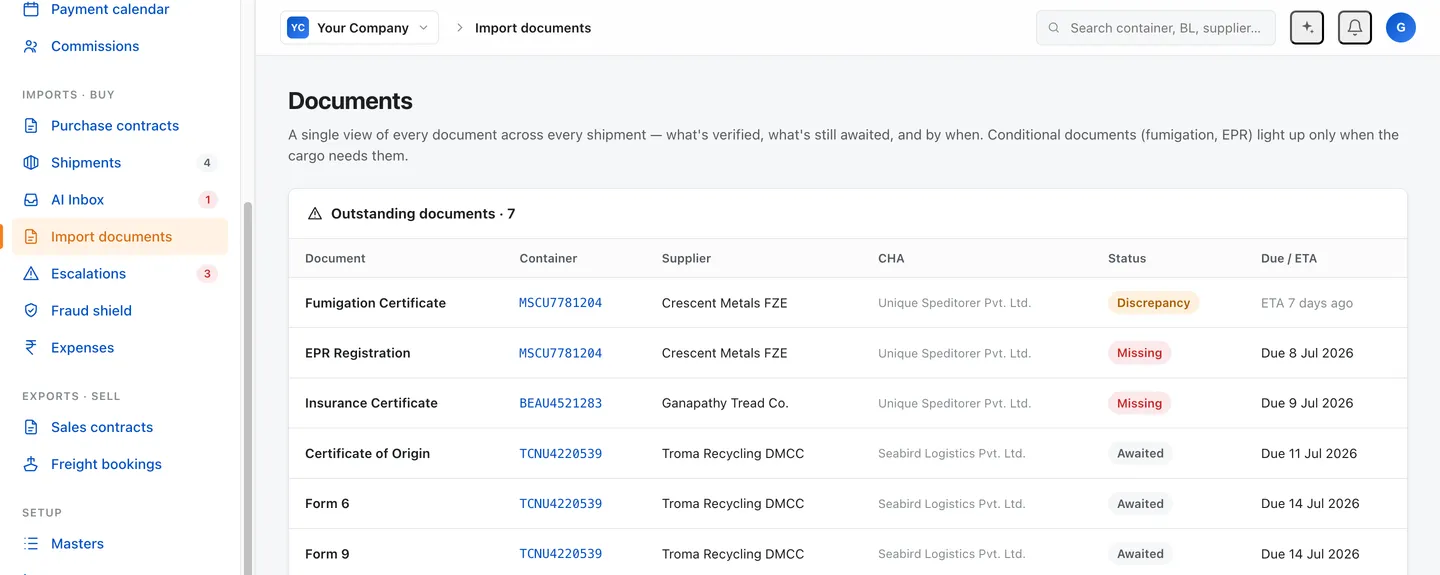
That is the work customs documentation checks should be doing before the declaration is filed: every document in the pack checked against the others for the mismatches that get a declaration questioned, with a deadline on each one derived from the last free day rather than from the day the cargo lands.
Accreditation is worth asking about at volume
Dubai Customs runs a Client Accreditation Program for traders with a compliance record. Its guide sets the eligibility as registration with Dubai Customs as an importer or exporter, a free zone company or a customs broker, plus a good track record of compliance with customs laws, a high volume of trade, and quality controls with proper administrative and financial management. The benefits it lists include credit facilities, an account manager, and reduced customs intervention on declaration clearances.
That last one is the one worth the paperwork. Fewer interventions is fewer of the holds that turn a clean import into a demurrage conversation, and the eligibility test is mostly a description of a desk that already has its documents in order.
Questions traders ask
What is a clearing agent in Dubai?
The party that prepares and files your customs declaration. Dubai Customs licenses the role as a customs broker: its customer guide says any legal person can apply for a customs broker licence to prepare customs declarations, sign them and submit them to the customs office for another party's account, with the eligibility conditions set out in Customs Policy No. 17 of 2008. It is the role a Customs House Agent fills in India, a declaring agent fills in Singapore and a licensed customs broker fills in the United States.
Is a clearing agent the same as a customs broker in the UAE?
Same job, two names, and knowing both saves an argument. Clearing agent is the working term and the business type an importer registers against on the Dubai Trade portal. Customs broker is the licensed role in Dubai Customs' own documentation and in Customs Policy No. 17 of 2008. A licensed broker may also ask Dubai Customs to license a representative to act on their behalf.
Do I need a clearing agent to import into Dubai?
No. Dubai Customs' customer guide is explicit for an ordinary import from outside the GCC: the declaration can be submitted through online services by a registered Mirsal user, or by using the service of an authorised customs broker. Doing it in-house means holding your own registration and submitting through Mirsal 2 yourself. Most importers appoint an agent, and the ones that do not are usually clearing at volume.
What documents does a Dubai import declaration need?
For sea cargo imported to the local market from outside the GCC, Dubai Customs' guide lists the master or house bill of lading, the commercial invoice, the certificate of origin, the packing list, the delivery order and any permits that apply. The delivery order on that list is the detail importers miss: the declaration is waiting on a document that is itself waiting on charges being settled and the bill of lading released.
What does it cost to file a customs declaration in Dubai?
Dubai Customs publishes the service fee as AED 15 to AED 100 for an import declaration, with AED 20 in knowledge and innovation fees added on any service costing AED 50 or more, and a stated service time of two working hours. The fee is not the expensive part of a late declaration. The container sitting at the terminal is.
Sources
- Dubai Customs, Customer Guide, § 4 Customs Broker: 'Any legal person can apply to Dubai Customs for a license of a Customs Broker to engaged in the preparation of the Customs Declarations, signing and submitting them to the Customs Office for completing the Customs Procedures and Customs Clearance for the others' account'; eligibility conditions are set out in Customs Policy No. 17 of 2008, and a licensed broker may request a license for a representative to act on their behalf · checked 2026-09-12
- Dubai Customs, Customer Guide, § 15.10.1 Import to Local from Rest of World: 'Declaration can be submitted through online services by a registered Mirsal User or by availing the service of an authorized Customs Broker'; required documents for the sea channel are the master or house bill of lading, commercial invoice, certificate of origin, packing list, delivery order and permits wherever applicable · checked 2026-09-12
- Dubai Customs, Submit Customs Declaration service description: import declaration fees AED 15.00 – AED 100.00, AED 20 knowledge and innovation fees added on top of any service cost of AED 50 and above, service time two working hours, declarations processed through Mirsal 2 · checked 2026-09-12
- Dubai Customs, Customer Guide, Client Accreditation Program: eligibility requires registration with Dubai Customs as an importer/exporter, a free zone company or a customs broker, a good track record of compliance, high volume of trade and quality controls; benefits include credit facilities and reduced customs intervention for customs declaration clearances · checked 2026-09-12
- Docket operational baseline, import–export desk