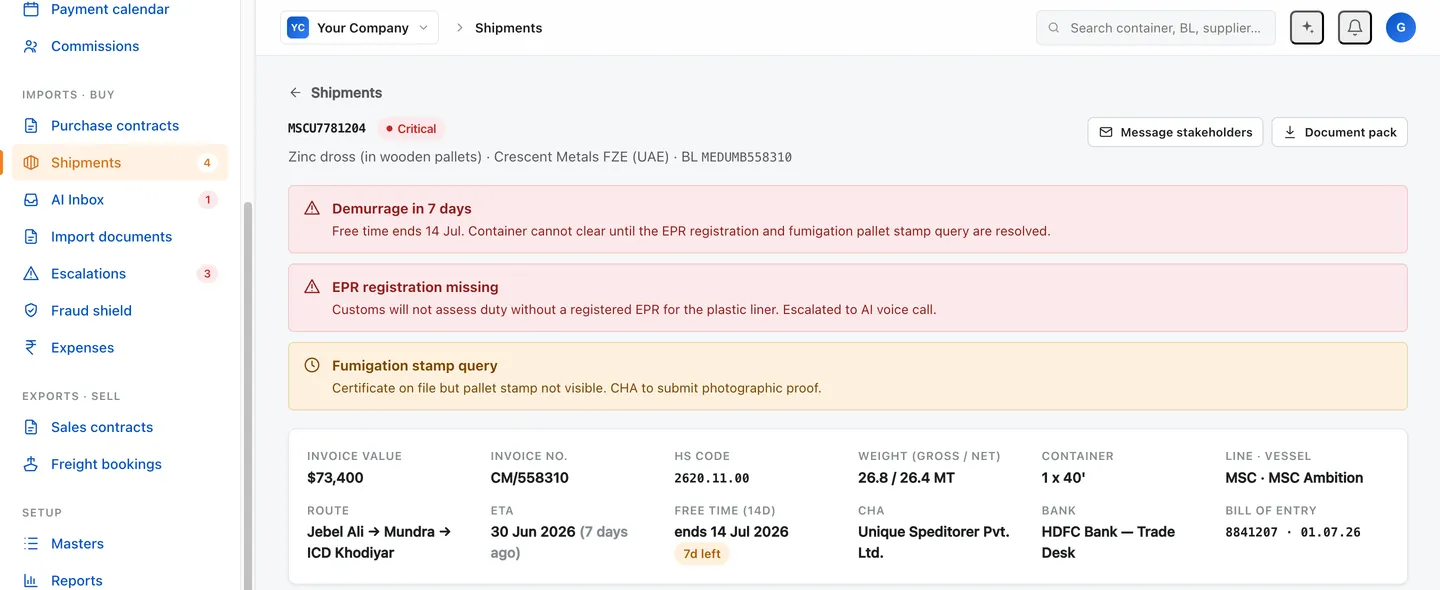
Gate-out: where demurrage stops and detention starts
Gate-out is the moment a laden import container is released through the terminal gate. It stops the demurrage clock and starts the detention clock, so it does not end the charges. It changes which one you are paying. The US billing rule splits the two by what is being occupied: marine terminal space, or the carrier's container. Gate-out switches the answer.
- Gate-out
- The release of a laden import container through the terminal gate, recorded on the equipment interchange receipt. It ends the container's occupation of terminal space, stopping demurrage, and begins the importer's use of the carrier's box, starting detention.
An import container generates charges from the day it is discharged to the day the empty is accepted back at a depot. Across that whole span there is exactly one event that changes which charge is running. It is the gate-out, and most desks record it as a logistics milestone rather than as the accounting event it is.
What happens at the gate
A truck arrives with a release against the delivery order, the terminal checks that customs has cleared the box and that the carrier’s charges are settled, and the laden container is driven out. The terminal writes an equipment interchange receipt: date and time, container and seal numbers, and the condition of the box as it left.
That receipt is the record. Not the date on the delivery order, not the date customs gave release, not the day your haulier says they collected it. When a carrier’s invoice and your file disagree about when the box left, the gate timestamp is what settles it, and it is the one document in the sequence that neither you nor your supplier produces.
One definition, two objects
The clearest statement of why gate-out matters is in the American billing rule, which defines both charges in a single sentence. Under 46 CFR § 541.3, demurrage or detention means any charges, including per diem charges, assessed by carriers or terminal operators “related to the use of marine terminal space (e.g., land) or shipping containers, but not including freight charges”.
Read the two objects in that sentence. Marine terminal space. Or shipping containers. The rule does not separate demurrage from detention by who bills you or by which port you are in. It separates them by which asset your cargo is occupying. While the box sits on the stack you are occupying the terminal’s land. Once it is out of the gate you are occupying the carrier’s container.
Gate-out is the event that changes the answer. That is the whole of it, and it explains the behaviour that confuses importers: the charges do not stop when the container is collected, because collecting it is precisely what moves you onto the second meter.
Two allowances, two expiry dates
Because they are two charges, they have two free-time allowances, and those expire on different days.
| Demurrage | Detention | |
|---|---|---|
| What you are occupying | Terminal space | The carrier’s container |
| Clock starts | Discharge from the vessel | Gate-out |
| Clock stops | Gate-out | Empty accepted at the nominated depot |
| Billed by | Terminal or carrier, per the tariff | The carrier |
Some lines sell a combined free time covering both, which sounds generous and hides which clock ate the days. The US rule is useful here even outside American trade, as a specification for what an invoice ought to tell you: § 541.6(b) requires a demurrage or detention invoice to carry the allowed free time in days, the start date of free time, the end date of free time and, separately, the container availability date on an import. A bill that cannot produce those fields per clock is a bill you cannot check.
Why the detention clock only makes sense after the gate
There is a reason detention starts at gate-out rather than at discharge, and it is not arbitrary. The charge exists to get the carrier’s box back. The Federal Maritime Commission’s interpretive rule says so by its converse at § 545.5(c)(2)(ii): practices that impose detention “when it does not serve its incentivizing purposes, such as when empty containers cannot be returned, are likely to be found unreasonable”.
A container still inside the terminal cannot be returned by you, because you do not have it. The incentive has nothing to bite on until the box is in your possession, which is what gate-out means. The same logic runs the other way at the end: if the nominated depot turns your truck away, the clock is still running on a return you were prevented from making, and that is the argument the rule leaves open.
Nothing at the gate is the terminal’s fault
The delays that push a gate-out past the last free day are almost never at the gate.
- The delivery order has not been issued, because the arrival charges are unsettled or the bill of lading is not released.
- Customs has not given release, because the declaration is queued behind a document that has not arrived from the supplier.
- There is no haulier slot, or no terminal appointment, on the day everything else came together.
Each of those sits with a different party, and none of them reports to you. That is the shape of the problem the arrival notice does not solve either: you are told the cargo has landed, and told nothing about the three dependencies between that message and a truck leaving the gate.
What a desk should do with the date
Two things, and both of them are dull.
Capture the gate-out timestamp from the interchange receipt, into the shipment file, on the day it happens. It is the closing entry on one charge and the opening entry on another, and reconstructing it four weeks later from a haulier’s WhatsApp message is how disputes are lost.
Plan backwards from it, not forwards from arrival. The date that decides whether you pay demurrage is the gate-out, and the gate-out is gated by a delivery order, a customs release and a truck. Work back from the free time you were actually allowed, put a deadline on each dependency, and chase the party that owes it before the week it is due.
That second habit is what any serious attempt to reduce demurrage costs has to automate. Watching a countdown does not move a gate-out forward. Getting the delivery order, the declaration and the truck lined up on the same morning does, and each of those is a person who has to be asked, and asked again.
Questions traders ask
What is gate-out in shipping?
The moment a laden import container leaves the terminal through the gate, on a truck or by rail. The terminal records it on an equipment interchange receipt, which carries the date and time, the container and seal numbers and the condition of the box as it left. That timestamp, not the delivery order date and not the customs release date, is the one a carrier and a terminal will both work from.
Does gate-out stop demurrage?
Yes, and that is all it stops. Demurrage is charged on a container occupying terminal space, so when the box leaves the terminal the demurrage meter stops. Detention is charged on the carrier's equipment being out with you, so the same event starts that meter. Nothing about gate-out ends the charges; it moves you from one tariff line to the other.
When does detention start on an import container?
At gate-out, and it runs until the empty is accepted back at the depot the carrier nominates. The detention free time is a separate allowance from the demurrage free time, with its own number of days and its own expiry date, so a container can be inside its detention free time and days past its demurrage last free day at the same time.
Can I be charged demurrage and detention on the same container?
Routinely, and importers who call the whole thing demurrage never find out which part was which. They are two charges on two clocks separated by one event. If a single invoice shows one free-time window covering both, ask which clock each day was billed against. The US billing rule requires an invoice to carry the allowed free time in days, the start date of free time and the end date of free time as separate fields.
What does 'gate out empty' mean on container tracking?
It is the other end of the same event, on the empty leg. 'Gate out empty' means the carrier's empty container has left a depot or terminal — usually on its way to a shipper for stuffing, so on an export it is the start of the free time for stuffing rather than anything on your import. On an import, the status you are waiting for is the opposite one, 'gate in empty at depot', which is the moment the empty is accepted back and the detention clock stops. Read the words in the order of the box, not the order of the shipment: out of the depot, or back into it.
What does 'gate out to consignee' mean?
The laden import container has left the terminal on a truck against your delivery order. That is the gate-out this page is about: demurrage stops on that timestamp and detention starts on it. If the tracking shows 'gate out to consignee' and your file still shows the box at the port, the demurrage you are accruing has already become detention.
What is an equipment interchange receipt?
The document exchanged when a container changes hands between the terminal and a haulier, in either direction. On the way out it records the gate-out time and the condition of the box; on the way back in it records the empty's return. Both ends of the detention clock are written on an interchange receipt, which is why a copy of each belongs in the shipment file rather than in a driver's cab.
Sources
- 46 CFR § 541.3, Definitions: 'Demurrage or detention' means any charges, including 'per diem' charges, assessed by ocean common carriers, marine terminal operators, or non-vessel-operating common carriers 'related to the use of marine terminal space (e.g., land) or shipping containers, but not including freight charges' — one definition covering both charges, distinguished by which asset is occupied · checked 2026-09-13
- 46 CFR § 541.6(b), Contents of invoice: a demurrage or detention invoice must at a minimum carry the invoice date, the invoice due date, the allowed free time in days, the start date of free time, the end date of free time, the container availability date for imports, the earliest return date for exports, and the specific dates for which demurrage or detention were charged · checked 2026-09-13
- 46 CFR § 545.5(c)(2)(ii), Empty container return: 'Practices and regulations that provide for imposition of detention when it does not serve its incentivizing purposes, such as when empty containers cannot be returned, are likely to be found unreasonable' · checked 2026-09-13
- Docket operational baseline, import–export desk