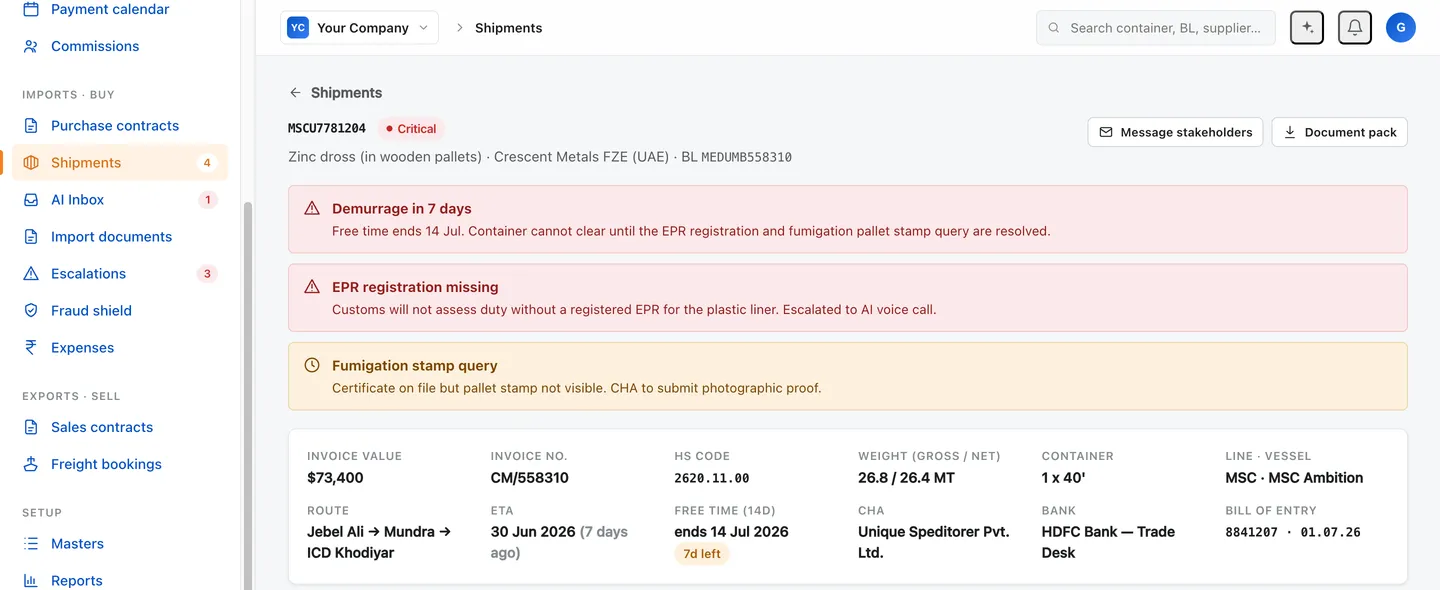
Dwell time: one box, three different numbers
Dwell time is how long a container occupies space between the event that starts the count and the event that ends it. It is a measurement, not a charge, which is why three parties quote three different dwell figures for one box: the terminal counts from discharge or receipt, the carrier from gate-out, and a US port authority may run a separate dwell fee on its own clock.
- Dwell time
- The period for which a container occupies space between the event that starts the count and the event that ends it. Dwell is a measurement, not a bill: each tariff and contract names its own start event, so one container can carry several different dwell figures at once.
Dwell time is how long a box sits. That is the whole definition, and it is why the word causes so much trouble: it names a measurement, so it cannot be read off an invoice, and nothing in it says which two events the measuring runs between.
Ask the terminal and dwell is the ground time: discharge or receipt at one end, the gate at the other. Ask the carrier and dwell is the equipment time, which starts at the gate and ends when the empty comes back. Ask a port authority in the United States and dwell may be the name of a charge rather than a period at all. Three honest answers, one container, three different numbers.
Dwell is the days; demurrage is the money
The useful way to hold the two apart is that dwell is an input and the charges are outputs. A container that dwells ten days at a terminal allowing ten free days costs nothing in storage. The same ten days at a terminal allowing two is eight chargeable days. So a dwell figure on its own does not tell you what a box cost; it tells you what to multiply once you know the free period and the event it ran from.
Which is the practical reason the number is worth so little when it arrives without its start event. “Nine days dwell” is not an answer to “what do we owe”. The last free day is the answer, and it is derived from the tariff, not from the dwell count.
When dwell becomes the charge’s own name
At Port Houston dwell is not a measurement the tariff takes and prices. It is a line item. The Sustained Import Dwell Fee is $48.53 per unit per day from the eighth day after free time expires, flat across every container length, and the tariff is explicit that it “will be charged in addition to the demurrage for loaded import containers” and “does not replace those charges.”
So a 40-foot import container collected fifteen days late at Houston is accruing $71.55 a day of demurrage across the overstay and $48.53 a day on top of it for the last eight days. Both are the port authority’s charges on the same ground. The carrier’s detention on the equipment has not started, because the box has not left the gate.
The word runs the other way in India. Nhava Sheva’s terminal scales of rates grant a free dwell time on an import container, meaning the allowance rather than the overstay, counted from the day following the day of landing and, at NSICT, “exclusive of customs notified holidays and port’s non-working days”. Same word, opposite side of the clock.
The regulator has already noticed
This is not a translation problem a desk has to solve on its own. The Federal Maritime Commission’s interpretive rule on demurrage and detention, 46 CFR § 545.5, has a paragraph headed Transparent terminology. The Commission may consider
the extent to which regulated entities have clearly defined the terms used in demurrage and detention practices and regulations, the accessibility of definitions, and the extent to which the definitions differ from how the terms are used in other contexts
A charge whose own tariff never says what it measures is weaker in a dispute than one that does. That cuts the importer’s way, and it is worth knowing which of the fees on a bill rests on a defined term and which does not.
Two more parts of the same rule matter here. Paragraph (b) sets the scope, and it is drawn by function rather than by name: the rule reaches “any charges, including ‘per diem,’” raised by a carrier, a marine terminal operator or an intermediary “related to the use of marine terminal space (e.g., land) or shipping containers”. A fee called a dwell fee, levied by a terminal for the ground a box occupies, is inside that description whatever the subrule calls it.
And paragraph (c) is the one to read before writing a dispute letter. The Commission will consider “the extent to which demurrage and detention are serving their intended primary purposes as financial incentives to promote freight fluidity”, and charges raised where they cannot incentivise anything, its own example being detention “when empty containers cannot be returned”, are “likely to be found unreasonable.” Dwell the importer had no way to shorten is the weakest ground a charge can stand on.
Why a desk cannot just read dwell off a screen
Three figures, three custodians, and not one of them publishes the number you need.
The terminal’s clock starts at an event in its tariff: receipt, landing, or the first 6 a.m. after receipt. The tariff edition in force on the day of arrival decides which. The carrier’s clock starts at gate-out and its free period is a contract term rather than a published one. And the day the cargo actually became collectable, which is the only one the importer’s own performance is fairly measured against, is the container availability date, which moves for customs holds and examinations nobody at the desk controls.
Working all three back to a single date per box, per terminal, per tariff edition, and knowing which one is about to bite first, is what demurrage and detention software that counts dwell against each tariff exists to do. A dashboard showing dwell in days is showing the input. The question is always which deadline comes next and what it costs after it.
Questions traders ask
What does dwell time mean in shipping?
How long a container sits in one place before moving on. On an import it usually means the time between the box being discharged or received at the terminal and the day it leaves the gate. Dwell is a measurement rather than a charge: demurrage, terminal storage and a port authority's dwell fee are the charges that get calculated from it, each on a clock its own tariff defines.
What is the difference between dwell time and demurrage?
Dwell time is the number of days; demurrage is the money. A box can dwell for ten days and attract no demurrage if the tariff allowed ten free days, and it can dwell for three and attract plenty if free time was two. Reading a dwell figure as a demurrage exposure only works if you also know which free period the tariff granted and which event it counted from.
What is an import dwell fee?
A charge some port authorities levy on an import container that stays past a stated number of days, separate from and in addition to demurrage. Port Houston's Sustained Import Dwell Fee is $48.53 per unit per day from the eighth day after free time expires, flat across every container length, and its own tariff says it "does not replace" the demurrage charges. It also has to be paid before the unit leaves the gate.
What is free dwell time?
The same thing as the terminal's free time, under the name several Indian tariffs use for it. Nhava Sheva's terminal scales of rates speak of the free dwell time allowed on an import container, counted from the day following the day of landing and exclusive of customs notified holidays and port non-working days. The word dwell there describes the allowance; at a US port it is more likely to name the charge that starts after one.
Can a carrier charge for dwell the importer could not avoid?
It can raise the charge, and the question of whether the charge is reasonable is a separate one that US law answers after the invoice. The Federal Maritime Commission's interpretive rule at 46 CFR 545.5 says it will consider the extent to which demurrage and detention serve their purpose as financial incentives to promote freight fluidity, and that charges imposed when they cannot incentivise anything — its example is detention when empty containers cannot be returned — are likely to be found unreasonable. That is an argument for a refund, not a pause on the meter.
Sources
- 46 CFR § 545.5, Interpretation of Shipping Act of 1984 — Unjust and unreasonable practices with respect to demurrage and detention. Paragraph (b) puts in scope "any charges, including 'per diem,' assessed by ocean common carriers, marine terminal operators, or ocean transportation intermediaries … related to the use of marine terminal space (e.g., land) or shipping containers, not including freight charges"; paragraph (c)(1) states the incentive principle; (c)(2)(ii) treats detention imposed "when it does not serve its incentivizing purposes, such as when empty containers cannot be returned" as "likely to be found unreasonable"; paragraph (e), Transparent terminology, has the Commission consider "the extent to which regulated entities have clearly defined the terms used in demurrage and detention practices and regulations, the accessibility of definitions, and the extent to which the definitions differ from how the terms are used in other contexts". Read via the eCFR versioner API at the 20 October 2026 issue · checked 2026-10-25
- Port of Houston Authority Tariff No. 14, Subrule No. 093A, and Tariff No. 15, Subrule No. 095A — the Sustained Import Dwell Fee of $48.53 per unit per day "commencing on the eighth day after expiration of free time", flat across container lengths, which "will be charged in addition to the demurrage for loaded import containers" and "does not replace those charges"; accrued fees "must be paid before it leaves the Terminal gate". Issued 31 July 2026, effective 1 September 2026 · checked 2026-10-17
- Nhava Sheva International Container Terminal Private Limited, Scale of Rates — the free dwell time allowed on an import container, counted from the day following the day of landing, "shall be exclusive of customs notified holidays and port's non-working days" · checked 2026-09-18
- Docket operational baseline, import–export desk · checked 2026-08-08