Freight forwarder: what the job covers, and what it does not
A freight forwarder arranges the movement of your cargo: booking space, preparing shipping documents, coordinating the box from origin to vessel. In the United States the regulator enumerates thirteen services that make up the job, and every one is a dispatch task. None is following up with a counterparty until a document arrives.
- Freight forwarder
- A party that dispatches shipments on behalf of others and arranges carriage for them, handling the booking and the shipping documents. In the United States it is a licensed ocean transportation intermediary, distinct from the separately licensed customs broker who files the declaration.
Ask an importer who is responsible for the documents on an inbound container and a good number will say the forwarder. Ask the forwarder and you will get a narrower answer, and the narrower answer is the correct one. In the one jurisdiction that writes the job down as a list, the list has thirteen items on it and none of them is the work that goes wrong.
The definition, and the direction it points
US law regulates forwarders as ocean transportation intermediaries, a category with two members: the ocean freight forwarder and the non-vessel-operating common carrier. The forwarder half is defined as a person that
In the United States, dispatches shipments from the United States via a common carrier and books or otherwise arranges space for those shipments on behalf of shippers; and Processes the documentation or performs related activities incident to those shipments
Read the direction. From the United States. The statutory ocean freight forwarder is an export-side role. Whoever an American importer calls their forwarder on an inbound box is, under this rule, something else: an NVOCC, which issues its own bill of lading and “is a shipper in its relationship with an ocean common carrier”; or a carrier’s own agent, which may forward without a licence but “only with respect to cargo carried under such carrier’s own bill of lading”; or a customs broker, which is a different licence from a different regulator. One word, three legal positions, and they carry different liabilities.
The thirteen services
Freight forwarding services are defined as “the dispatching of shipments on behalf of others, in order to facilitate shipment by a common carrier”, and then enumerated: ordering cargo to port, preparing export documents, booking and confirming cargo space, preparing delivery orders and dock receipts, preparing bills of lading, processing consular documents, arranging warehouse storage, arranging cargo insurance, assisting with export clearance, sending advance notifications to banks, shippers or consignees, handling freight monies, coordinating the movement from origin to vessel, and giving expert advice on letters of credit and documents.
They are all verbs of dispatch. Order, prepare, book, arrange, coordinate, advise. The one that comes closest to follow-up is “preparing and/or sending advance notifications of shipments or other documents to banks, shippers, or consignees, as required” — and that is sending a notification, not extracting a document from somebody who has not sent it.
So when a desk says the forwarder will get the certificate of origin out of the supplier, it is describing a service that is not in the definition of the job and usually not in the contract either. What a good forwarder will reliably do is tell you the document is not there. The ten days between being told and having it are yours.
Whose agent, and who is paying
The rule uses two different words for money moving to a forwarder, and the difference is worth a minute.
A freight forwarding fee is “charges billed by an ocean freight forwarder to a shipper, consignee, seller, purchaser, or any agent thereof”. That is your invoice. Compensation, in the same definitions, means “payment by a common carrier to a freight forwarder for the performance of services as specified in § 515.2(h)”. That is the line’s invoice, for the same list of services.
Both are lawful and both are ordinary. The tell that this is a real feature of the arrangement rather than a suspicion is the carve-out: an importer forwarding its own cargo without a licence “shall not receive compensation from the common carrier”. The rule has to say so precisely because paying the forwarder is what carriers do.
None of that makes a forwarder untrustworthy. It does mean that when a demurrage invoice is contested, the party who booked the space may be commercially closer to the party who issued the charge than to you, and the dated record of who was asked for what is yours to hold rather than theirs to produce.
The word for the other half of the job, by market
Clearing goods is a separately licensed activity almost everywhere, and the name changes at the border. In the United States a customs broker is “a person who is licensed under this part to transact customs business on behalf of others”, customs business being the entry and admissibility of merchandise, its classification and valuation and the duties on it. In Singapore the counterpart is the declaring agent lodging a permit declaration through TradeNet; in Dubai the clearing agent filing through Mirsal 2; in India the Customs House Agent, and the full vocabulary table sits on that entry.
A forwarder may hold both roles, one, or neither. The question worth asking before a shipment rather than during one is which of them your invoice is buying.
The forwarder’s invoice is the freight line, and it arrives late
One practical consequence of the two roles above: whichever hat the forwarder is wearing, its invoice is where most of the freight cost on a shipment actually lands, and it rarely lands before the goods do. Ocean freight, origin charges, documentation fees, the delivery order charge and whatever the destination agent adds arrive over weeks, from more than one party, after the costing was signed off.
That is the gap between quoting a rate and knowing a cost. Software sold as freight cost management software usually manages the rate before the booking; what a desk is missing afterwards is each charge captured against the container, traced to the email it came in on, so the figure can be checked against the quote rather than accepted.
What is left over, and who does it
Strip out the dispatch list and the declaration, and what remains on an import is the part nobody’s licence covers: finding out whether the supplier has produced the pack, and going back until it has. Six parties touch a shipment and none of them owns that. Document packs routinely run about eight days late against free time, which is a fact about the gap between the jobs rather than about any one of the parties doing theirs badly.
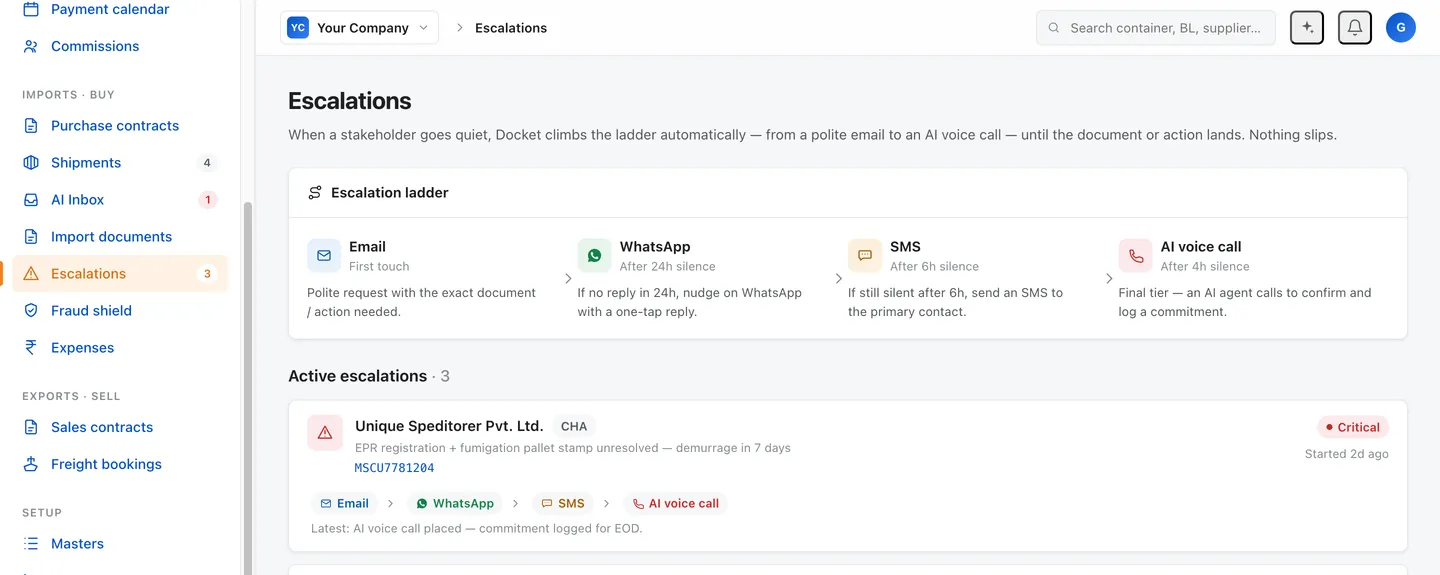
That gap is the whole of what supplier follow-up automation is for: the daily ask, on the channel the counterparty already uses, escalating until the document is in the file — with every request and reply dated, so the record exists before anybody needs it.
Questions traders ask
What does a freight forwarder actually do?
It arranges the movement. The US regulator's own list of freight forwarding services runs to thirteen items, and they are all dispatch: ordering cargo to port, booking and confirming cargo space, preparing bills of lading, delivery orders and dock receipts, arranging warehouse storage and cargo insurance, handling freight monies, coordinating the movement of shipments from origin to vessel, and giving expert advice on letters of credit and documents. That is a real job and a useful one. It is not the same job as making a supplier send you a certificate.
What is the difference between a freight forwarder and a customs broker?
Two different licences, and in the United States two different regulators. A forwarder is an ocean transportation intermediary licensed by the Federal Maritime Commission; a customs broker is licensed by CBP to transact customs business — the entry and admissibility of merchandise, its classification and valuation, and the duties assessed on it. One arranges the carriage, the other files the declaration. The same company often sells both, which is why the distinction only becomes visible when something goes wrong.
What is the difference between a freight forwarder and an NVOCC?
Who carries the liability. A non-vessel-operating common carrier is defined as a common carrier that does not operate the vessels and 'is a shipper in its relationship with an ocean common carrier' — it issues its own bill of lading and buys space in its own name. A forwarder acts on behalf of a principal and does not become the carrier. In US law both are ocean transportation intermediaries and both need a licence, but only one of them is contractually your carrier.
Does my freight forwarder chase my supplier for documents?
Only if your contract with it says so, and most do not. Nothing in the enumerated definition of freight forwarding services covers following up with a counterparty until a document arrives. The nearest item is preparing and sending advance notifications of shipments or documents to banks, shippers or consignees — sending, not chasing. A forwarder will usually tell you a document is missing. Getting it is the importer's problem, and it is the problem that produces demurrage.
Who pays the freight forwarder?
Sometimes both of you. The US rule distinguishes a 'freight forwarding fee', which is what the forwarder bills the shipper, consignee, seller or purchaser, from 'compensation', which it defines as payment by a common carrier to a freight forwarder for performing those same services. There is nothing improper in it and it is disclosed in tariffs, but it is worth knowing before assuming your forwarder is your agent in an argument with the line.
Do I need a licence to forward my own shipments?
In the United States, no. A person whose primary business is the sale of merchandise may dispatch and perform freight forwarding services on its own shipments, or those of a parent, subsidiary or affiliate, without a licence — but that person 'shall not receive compensation from the common carrier' for it. Acting for anyone else is different: no person in the United States may advertise, hold itself out, or act as an ocean transportation intermediary without a licence from the Commission.
Sources
- 46 CFR § 515.2(m), Definitions — "Ocean transportation intermediary (OTI) means an ocean freight forwarder or a non-vessel-operating common carrier"; an "Ocean freight forwarder (OFF) means a person that— (i) In the United States, dispatches shipments from the United States via a common carrier and books or otherwise arranges space for those shipments on behalf of shippers; and (ii) Processes the documentation or performs related activities incident to those shipments"; a "Non-vessel-operating common carrier (NVOCC) means a common carrier that does not operate the vessels by which the ocean transportation is provided, and is a shipper in its relationship with an ocean common carrier" · checked 2026-09-30
- 46 CFR § 515.2(h), Freight forwarding services — "the dispatching of shipments on behalf of others, in order to facilitate shipment by a common carrier", enumerated in thirteen items: ordering cargo to port; preparing and/or processing export documents including the required electronic export information; booking, arranging for or confirming cargo space; preparing or processing delivery orders or dock receipts; preparing and/or processing common carrier bills of lading or other shipping documents; preparing or processing consular documents or arranging for their certification; arranging for warehouse storage; arranging for cargo insurance; assisting with clearing shipments in accordance with United States Government export regulations; preparing and/or sending advance notifications of shipments or other documents to banks, shippers, or consignees, as required; handling freight or other monies advanced by shippers, or remitting or advancing freight or other monies or credit in connection with the dispatching of shipments; coordinating the movement of shipments from origin to vessel; and giving expert advice to exporters concerning letters of credit, other documents, licenses or inspections, or on problems germane to the cargoes' dispatch · checked 2026-09-30
- 46 CFR § 515.2(f) and (g) — "Compensation means payment by a common carrier to a freight forwarder for the performance of services as specified in § 515.2(h)"; "Freight forwarding fee means charges billed by an ocean freight forwarder to a shipper, consignee, seller, purchaser, or any agent thereof, for the performance of freight forwarding services". § 515.2(o): "Principal refers to the shipper, consignee, seller, or purchaser of property… who employs the services of a licensed freight forwarder". § 515.2(t): "Shipper" includes "(3) The person to whom delivery is to be made" · checked 2026-09-30
- 46 CFR § 515.3, License; when required — "no person in the United States may advertise, hold oneself out, or act as an ocean transportation intermediary unless that person holds a valid license issued by the Commission". § 515.4(a): a person whose primary business is the sale of merchandise may forward its own shipments without a licence but "shall not receive compensation from the common carrier for any services rendered in connection with such shipments". § 515.4(c): a common carrier or its agent may perform ocean freight forwarding services without a licence "only with respect to cargo carried under such carrier's own bill of lading". § 515.4(b)(3): an intermediary "is fully responsible for the acts and omissions of any of its employees and agents" · checked 2026-09-30
- 19 CFR § 111.1, Definitions — "Customs broker means a person who is licensed under this part to transact customs business on behalf of others"; "Customs business means those activities involving transactions with CBP concerning the entry and admissibility of merchandise, its classification and valuation, the payment of duties, taxes, or other charges assessed or collected by CBP on merchandise by reason of its importation, and the refund, rebate, or drawback of those duties, taxes, or other charges" · checked 2026-09-30
- Docket operational baseline, import–export desk · checked 2026-09-30