Chemical import documents, Singapore: licence then permit
In Singapore a chemical import turns on one document the supplier cannot produce: the importer's own hazardous substances licence from NEA, whose number goes in the TradeNet permit. The second problem is the clock. Dangerous cargo is not given the ordinary free time: at Jebel Ali an IMDG class 5 container gets none at all, and a class 8 container three days instead of ten.
- HS chapters
- 28 — Inorganic chemicals, compounds of precious metals and rare-earth metals · 29 — Organic chemicals · 32 — Tanning and dyeing extracts, pigments, paints and varnishes · 34 — Soap, organic surface-active agents, waxes · 38 — Miscellaneous chemical products
- Beyond the standard pack
- Hazardous Substances Licence from NEA's Chemical Control and Management Department, where the goods contain an ingredient in Part I of the Second Schedule to the Environmental Protection and Management Act · TradeNet import permit quoting that licence number in the Licence Number field, with the product code matched to the HS code · Dangerous goods declaration and container packing certificate under the IMDG Code, for cargo carried in packaged form under SOLAS chapter VII · Safety data sheet for each substance, matching the declared classification · Container and seal numbers, and for substances under the Hazardous Substances Regulations the maximum quantity per trip in kilograms
Most cargo pages are about documents. This one is about a document and a clock, and the clock is the half that surprises people.
A chemical import carries the ordinary pack: invoice, packing list, bill of lading, certificate of origin. Then it carries a set the regulation adds. What makes it a different job from importing steel or rice is that the extra documents are gating rather than supporting. Without them the permit does not go in, and while the permit is not in, the box is standing somewhere that charges by the day at a rate set for cargo nobody wants parked.
The licence is the importer’s own, and it comes first
In Singapore the sequence is licence, then permit, then arrival, in that order. The first step is the one a supplier cannot help with.
Before a declarant submits an import permit to TradeNet, they have to check whether the goods contain an ingredient listed in Part I of the Second Schedule to the Environmental Protection and Management Act. If they do, the importer must hold a valid Hazardous Substances Licence issued by the Chemical Control and Management Department of the National Environment Agency, and that licence number goes into the Licence Number field of the permit application. The general exemptions sit in Part II of the same Schedule.
Singapore Customs states that permit applications are processed within five working days upon receipt of all required documents, and that an application is complete only when the trader holds the valid licence and any transport approval and has supplied the supporting documents. Read that carefully: the five days is the permit, once everything is in hand. The licence is a separate instrument the importer applies for and holds, and a consignment that sails against a licence somebody assumed was current is a consignment that waits.
This is the same shape as the plant quarantine import permit on agri commodities: the one document in the pack that is the importer’s own application, on the importer’s calendar, and therefore the one that gets forgotten because there is no counterparty to chase for it.
The free time is shorter, and sometimes it is zero
Here is the part that turns a paperwork delay into a large number.
Terminals do not give dangerous cargo the ordinary allowance. The published DP World tariff for Jebel Ali is the clearest illustration of the principle because it is a document rather than a negotiation:
| Cargo | Terminal free days from discharge | Then |
|---|---|---|
| Ordinary import full container | 10 | AED 82 a day up to 20ft, AED 164 over 20ft, rising after five days |
| IMDG class 8, corrosives | 3 | The same bands |
| IMDG class 5, oxidising substances | 0 | AED 500 per container per day for the first 10 days, AED 1,000 a day thereafter |
A class 5 container is accruing a charge from the day it is discharged. There is no grace period in which to find a missing safety data sheet.
Two things follow. The first is that the last free day on a dangerous cargo has to be computed from that cargo’s own allowance, not from the desk’s habitual assumption about the port. The second is that the carrier’s free time is a separate clock from the terminal’s, set in your service contract, and an importer clearing a chemical late pays both, at rates neither of which is the one they budgeted.
Check the tariff for the terminal you actually clear at. Jebel Ali is quoted here because its schedule is published; the allowance at your terminal is a different number and it is also a published one.
Three documents that have to say the same thing
Beyond the licence, the chemical pack adds a small set with an unusual property: they are read by different parties, each of whom will stop the box for a different reason, and they must agree.
A dangerous goods declaration from the shipper and a container packing certificate from whoever packed the unit, both required for dangerous goods carried in packaged form under the IMDG Code. That Code is the IMO’s rulebook for the maritime transport of dangerous goods in packaged form, covering packing, container traffic and stowage with particular reference to the segregation of incompatible substances, and it is mandatory as an extension of SOLAS chapter VII.
A safety data sheet for each substance.
And the product code matched to the HS code in the permit, with container and seal numbers, plus the maximum quantity per trip in kilograms where the substance falls under the Hazardous Substances Regulations.
The failure mode is boring and it is the common one. The declaration says one UN number, the safety data sheet was issued for a slightly different grade, and the HS code on the invoice belongs to a third classification the supplier’s back office has always used. Each is defensible on its own. Together they are a query, and a query on a class 5 container is a query with a meter running.
What this costs an import desk
The arithmetic is the same as any other cargo, with less room in it.
Desk work runs about 2.2 hours a container, of which 30 to 45 minutes is supplier follow-ups and 45 to 90 minutes is document-pack preparation and checking. Document packs routinely run about eight days late against free time. On an ordinary container with ten free days, eight days of lateness is uncomfortable. On a class 8 container with three, it is already over. On a class 5 container with none, there was never a margin to spend.
That is why the chemical desk is the one where people build private spreadsheets and check them at night. The deadline is earlier than the habit, and the habit was formed on cargo that forgave it.
Where Docket sits
Docket does not classify your chemicals and does not apply for your licence. Classification is your own responsibility and the licence is your application to the authority.
What it does is treat the licence as a dated obligation from the moment the purchase contract is recorded, rather than as something remembered when the arrival notice lands. It chases the supplier for the dangerous goods declaration, the packing certificate and the safety data sheet on the channels the supplier already uses: email, then WhatsApp at 24 hours, SMS at 48, an AI voice call at 72. It reads the classification on each document against the others and against the contract, so a UN number that disagrees with a safety data sheet surfaces before the booking rather than at the gate.
Then it counts backwards. Every deadline in the pack derives from the last free day, and on dangerous cargo it derives from a shorter one. That is the job demurrage and detention software is for, and on this cargo it is doing it against a clock that starts earlier and charges more.
The jobs Docket does on this cargo
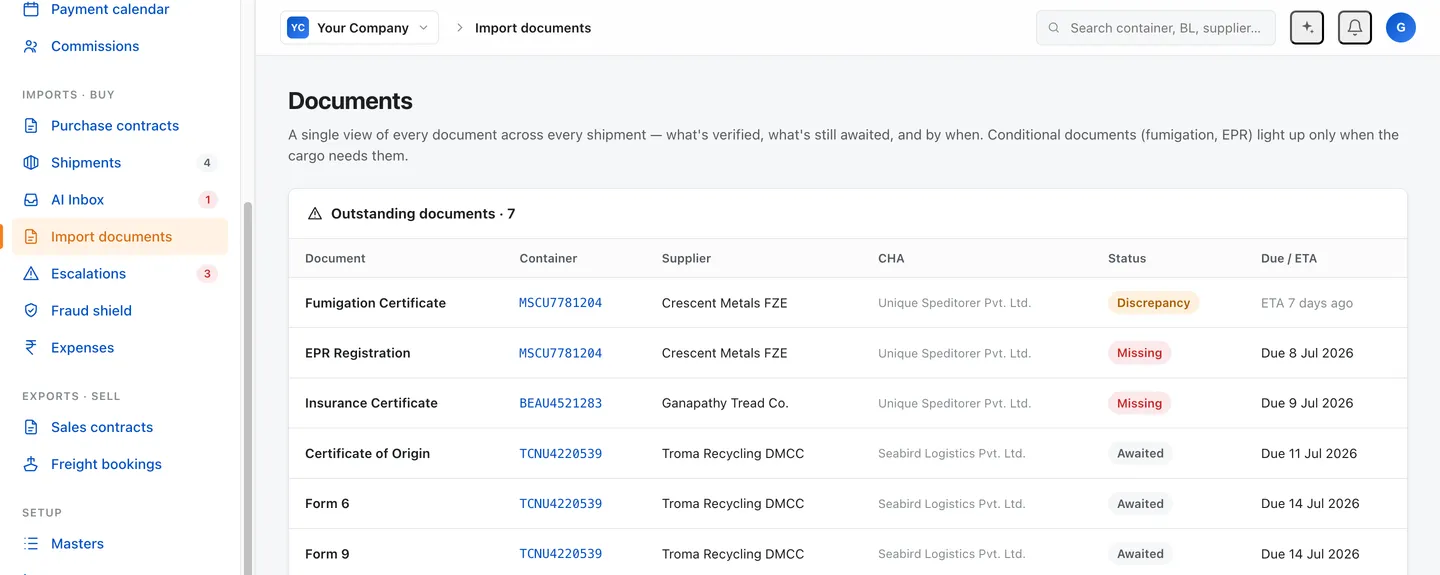
- Checks every document is present & correct — BL, invoice, COO, packing list, insurance — verified against your checklist, per container.
- Chases suppliers daily — schedules, prices, docs — Loading schedules until confirmed, prices every morning, and whoever owes the missing document.
- Escalates on WhatsApp / call when it's urgent — Email first. Then WhatsApp, SMS and an AI voice call — automatically.
- Builds your payment calendar itself — Loading confirmed → payables scheduled from your terms; receivables follow the sales contract. Currencies kept separate.
- Tracks every expense — traced to its email — Duty, port charges, CHA fees, detention — pulled from invoice emails, so each container's landed cost is live. Every line links to the email it came from.
Questions importers of this cargo ask
What licence do I need to import chemicals into Singapore?
Before you submit the permit, check whether the goods contain an ingredient listed in Part I of the Second Schedule to the Environmental Protection and Management Act. If they do, the importer must hold a valid Hazardous Substances Licence from the Chemical Control and Management Department of the National Environment Agency, and the declarant has to put that licence number in the Licence Number field of the TradeNet application. The general exemptions are in Part II of the same Schedule.
How long does a Singapore chemical import permit take?
Singapore Customs states that permit applications are processed within five working days upon receipt of all required documents, and that an application is only considered complete when the trader holds a valid hazardous substances licence and any transport approval, with the supporting documents provided. Five working days is the processing time for a complete application, not the lead time for the licence itself. The licence is a separate, earlier thing to hold.
Does dangerous cargo get the same free time as ordinary cargo?
No, and this is the part that costs money. Free time on dangerous cargo is cut or withdrawn because the terminal does not want it standing there. At Jebel Ali an ordinary import full container gets ten free days of terminal storage from discharge; an IMDG class 8 corrosives container gets three; and an IMDG class 5 oxidiser gets no free time at all, charged AED 500 per container per day for the first ten days and AED 1,000 a day after that. Check the tariff for the terminal you are actually clearing at, because the allowance is a published document and it differs.
Which documents does the chemical pack add beyond the normal set?
Three, and they have to agree with each other. A dangerous goods declaration from the shipper and a container packing certificate from whoever packed the unit, both required for packaged dangerous goods carried under the IMDG Code. A safety data sheet for each substance. And the licence and product code in the permit itself. The classification on the declaration, the classification on the safety data sheet and the product code against the HS code all have to say the same thing, because they are read by different people who each stop the consignment for a different reason.
What is the IMDG Code and what makes it mandatory?
The International Maritime Dangerous Goods Code is the IMO's rulebook for the maritime transport of dangerous goods in packaged form, covering packing, container traffic and stowage, with particular reference to the segregation of incompatible substances. It is an extension of the provisions of SOLAS chapter VII, which is what makes it mandatory rather than advisory. It is also why your carrier will refuse a booking on a paperwork defect that a non-hazardous cargo would have carried through.
Does Docket apply for the hazardous substances licence?
No. The licence is the importer's own application to NEA and Docket has no part in it. What Docket does is put it on the calendar from the contract date rather than the arrival notice, chase the supplier for the dangerous goods declaration, the packing certificate and the safety data sheet before loading instead of after, read the classification on each against the others and against the purchase contract, and count every one of those dates back from a last free day that is shorter than the one people are used to.
Sources
- Singapore Customs, Competent Authorities Requirements for Controlled Items, National Environment Agency, Chemical Control and Management Department (Hazardous Substances): the Hazardous Substances Licence, Part I of the Second Schedule to the Environmental Protection and Management Act, the TradeNet Licence Number field, and processing within five working days of a complete application · checked 2026-09-09
- International Maritime Organization, International Maritime Dangerous Goods (IMDG) Code: the maritime transport of dangerous goods in packaged form, covering packing, container traffic and stowage with particular reference to the segregation of incompatible substances, as an extension to the provisions of SOLAS chapter VII · checked 2026-09-09
- DP World UAE Region Tariff Book, November 2023 edition, § 119 (Free Time) and § 511.1 (Container Storage Rates): ten free days for ordinary import full containers, three for IMDG class 8, none for IMDG class 5 at AED 500 then AED 1,000 per container per day · checked 2026-09-08
- World Customs Organization, Harmonized System Nomenclature, Chapters 28, 29, 32, 34 and 38
- Docket operational baseline, import–export desk