Demurrage and detention software: whose calendar?
Five published container tariffs disagree on three things: which day is day zero, whether Saturdays and public holidays count, and whose holiday calendar applies. ONE's Singapore tariff counts working days excluding Ministry of Manpower holidays; Mundra's counts calendar days including Sundays and holidays. Software that stores free time as one number per shipment cannot be right at both.
Every product sold as demurrage and detention software stores a number of free days somewhere. The question worth asking in a demo is not how many days it holds. It is what it thinks a day is.
Five published tariffs this site has now read, across four countries, disagree on that, and they disagree in three independent ways at once.
The two that are exact opposites
Ocean Network Express’s Singapore agency tariff allows four working days of inbound demurrage. Its own note defines the unit:
Work days, where mentioned refers and excludes Saturday, Sunday and Public Holidays declared by the Ministry of Manpower, Singapore.
Adani’s Mundra terminal tariff allows two free days on a road-evacuated import container, counted “from the day of landing, up to the day of loading, delivery or removal of the container, and including Sundays and holidays”, where “per day” means “per calendar day or part thereof”.
One excludes weekends and a national holiday calendar. The other explicitly includes them. Both are the current published document for their port. A field called “free days” holds the same integer for both and is wrong about one of them.
What that costs, arithmetically
Take a box discharged at Singapore on Friday 13 February 2026. Chinese New Year falls on the Tuesday and Wednesday of the following week. The four working days land on Monday the 16th, Thursday the 19th, Friday the 20th and Monday the 23rd. The allowance expires on Monday 23 February — ten calendar days after discharge.
The same four working days on a box discharged on a Monday in an ordinary week expire on the Friday: four calendar days. One tariff, one port, one allowance, and the deadline moves by six days depending on which day the vessel worked.
A reminder set for “day 4” is wrong in both cases: early in February, and on time only by accident in April. Six days of error at about US$12,000 for a week of demurrage on one container is not a rounding problem.
Day zero is a third variable, and nobody agrees on it
The counting unit is only half of it. The tariffs also disagree about which day the count starts on:
| Port | Tariff | Free period | Day zero, in the tariff’s words |
|---|---|---|---|
| Singapore | ONE, carrier | 4 working days | “discharged from vessel”, in 24-hour blocks |
| Jebel Ali | DP World, terminal | 10 days | “the date of discharge from the vessel” |
| Khalifa Port | CMA Terminals | 10 days | “per day, including the discharge date” |
| Nhava Sheva | NSICT, terminal | 3 days | “the day following the day of landing” |
| Mundra | Adani, road evacuation | 2 days | “the day of landing” |
Nhava Sheva starts a day later than Mundra on the same event. On a three-day allowance that one day is a third of the free period. And NSICT adds an exclusion of its own: free dwell time there is “exclusive of customs notified holidays and port non-working days”, which is a different calendar again from the Ministry of Manpower’s.
So there are three settings, not one: day zero, whether non-working days count, and whose list of non-working days. No two of these five tariffs answer all three the same way.
The question that finds out
Most demurrage and detention tools are built on a container-tracking feed. A feed gives you events: discharged, gated out, empty returned. Turning an event into a deadline is the part that needs the tariff, and the tariff is the part nobody ships with the product.
So in the demo, ask to see the screen where you set the rule. Not the screen that shows the countdown, but the screen where day zero, the weekend rule and the holiday calendar are configured, per terminal and per carrier. If that screen does not exist, the countdown on the dashboard is a subtraction, and you will find out which lane it was wrong about when the invoice arrives.
While that screen is open, check the field above the day count as well: the carrier the figure was read from. On a booking moving under a house bill of lading the carrier on your bill of lading may not own a ship, and a tool resolving free time from the vessel operator is quoting a contract you are not party to: counted perfectly, out of the wrong tariff.
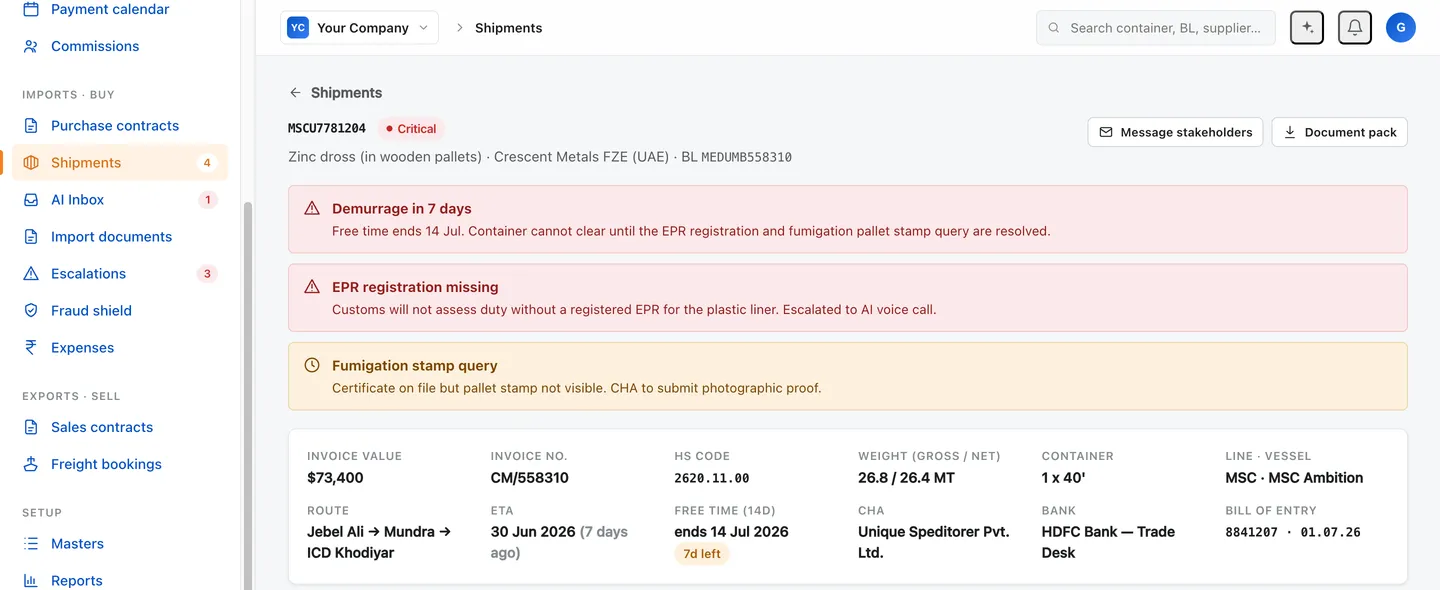
Then ask the second question, which is the one that decides the money: when the allowance is about to be spent because a supplier has not sent the certificate, what does the product do? Document packs routinely run about eight days late. Against four working days at Singapore or two at Mundra, the allowance is gone before the pack is complete, and nothing about counting it more precisely fixes that.
Counting correctly is the minimum. Demurrage and detention software that counts in the tariff’s own unit and then goes and chases the missing paper is the part that changes the invoice. If you want to work out what an overstay cost on your own lane, the demurrage calculator takes the free days and the per-diem tiers off your own contract. Now you know to check what kind of day you are typing in.
Questions this raises
What should demurrage and detention software let me configure?
Three things, per terminal and per carrier: which event day zero is, whether weekends and public holidays are excluded from the count, and which holiday calendar applies. Every one of those varies between the published tariffs of ports an ordinary importer uses, so a product that stores free time as a single number of days per shipment is guessing at two of the three.
Is free time counted in calendar days or working days?
It depends entirely on the tariff, which is the point. Ocean Network Express's published Singapore tariff counts working days and excludes Saturday, Sunday and the public holidays the Ministry of Manpower declares. Adani's Mundra terminal tariff counts calendar days and says so: the free period runs "including Sundays and holidays", and "per day" means "per calendar day or part thereof". Both are current published documents and they are opposites.
How many calendar days is four working days at Singapore?
Between four and ten, depending on the sailing. A box discharged on a Monday in an ordinary week uses its four working days by Friday. A box discharged on Friday 13 February 2026 has Chinese New Year on the Tuesday and Wednesday of the following week, so its four working days fall on 16, 19, 20 and 23 February — ten calendar days after discharge.
Why does the day-zero rule matter so much?
Because it moves every downstream date by one, and the tariffs disagree. NSICT at Nhava Sheva counts from the day following the day of landing. Mundra counts from the day of landing. Khalifa Port counts per day including the discharge date. On a three-day allowance, a one-day error in day zero is a third of the allowance.
Does a demurrage calculator solve this?
Only if you give it the right inputs, and it cannot know them for you. Our own demurrage calculator asks for your free days and your per-diem tiers because those come off your contract and your terminal's tariff, not off a table anyone can publish. What a calculator cannot do is chase the missing document that is spending the allowance in the first place.
Which tariffs did this post read?
ONE's Singapore agency Demurrage & Detention tariff, the DP World UAE Region Tariff Book for Jebel Ali, the CMA Terminals Khalifa Port schedule, JNPA's Scale of Rates for NSICT at Nhava Sheva, and the Adani tariff booklets for the Mundra container terminals. Each is linked in the sources below, and each port has its own page on this site carrying the full table.
Sources
- Ocean Network Express (Singapore) Pte Ltd Agency Office, Demurrage & Detention tariff, effective 15 July 2019 — 4 inbound demurrage workdays, 6 inbound detention workdays, and the working-day definition excluding Saturday, Sunday and Ministry of Manpower public holidays · checked 2026-09-24
- Ministry of Manpower, Singapore — public holidays declared for 2026, including Chinese New Year on 17 and 18 February · checked 2026-09-24
- Adani International Container Terminal Pvt Ltd (CT3), Mundra, Tariff Booklet effective 16 June 2026 — § 3.11 container storage, free period counted from the day of landing and including Sundays and holidays · checked 2026-09-19
- DP World UAE Region Tariff Book, November 2023 edition, § 119 Free Time — 10 free days from the date of discharge from the vessel at Jebel Ali · checked 2026-09-08
- Docket operational baseline, import–export desk · checked 2026-09-24