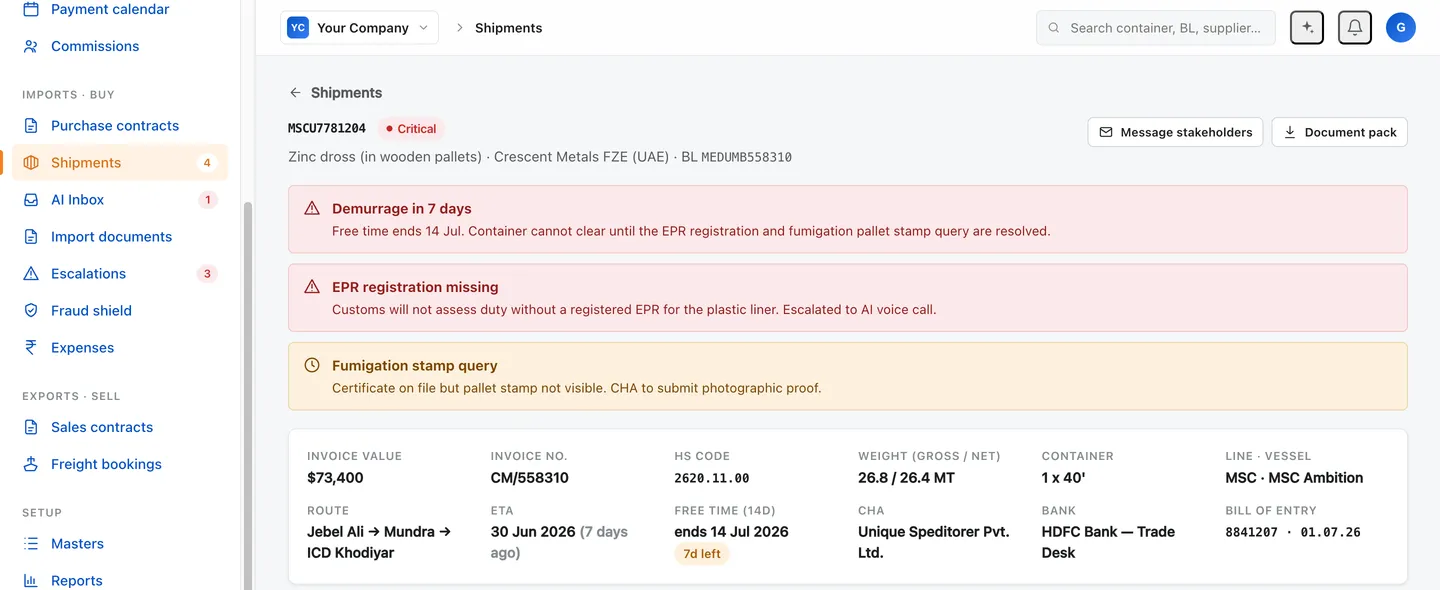
Goods detained at port: which clock you are on
A hold on a container runs on a deadline that depends on who placed it. A CBP detention gets a five-business-day decision and a 30-day final determination under 19 CFR 151.16; a hold placed for another agency is exempt from that section, and no period replaces it. Neither clock starts on arrival — it starts once the goods are devanned and viewable, while demurrage has run since discharge.
A container sits. The tracking screen says held. Somebody on the desk emails the broker, the broker emails the port, and the answer comes back as one word: customs.
That word covers two regimes with nothing in common except the box. One of them gives you dated deadlines you can hold the government to. The other gives you none, and the regulation says so in its first sentence.
The exemption is the first paragraph, not a footnote
19 CFR 151.16 is the detention regulation. It is the section that gives an importer a five-business-day decision, a written notice listing five things, and a final determination at 30 days with an appeal if the 30 days pass. It is the only part of the process with numbers in it.
Paragraph (a) is where it says who it does not cover:
The provisions of this section are not applicable to detentions effected by CBP on behalf of other agencies of the U.S. Government in whom the determination of admissibility is vested.
CBP is at the border for many agencies that decide admissibility themselves. When the hold is one of theirs, § 151.16 steps aside, and nothing in it is replaced with an alternative period. The five days are gone, the notice requirement is gone, the 30-day determination is gone, and so is the deemed exclusion that makes a missed deadline appealable.
Which means the first question on a hold is not how long and not why. It is whose. Everything you can do next, and every date you can put in a reply to a customer, turns on that answer, and it is the one question the word “customs” hides.
The clock does not start when the box arrives
Section 151.16(b) defines the starting gun:
For purposes of this section, merchandise will be considered to be presented for CBP examination when it is in a condition to be viewed and examined by a CBP officer. Mere presentation to the examining officer of a cargo van, container, or instrument of international traffic in which the merchandise to be examined is contained will not be considered to be presentation of merchandise for CBP examination for purposes of this section.
Read that twice, because it reverses the intuition. Delivering the container to the examination site does not start the five days or the 30 days. The goods have to be out of it and viewable. And the next sentence of the same paragraph says who pays for that: except at the public stores, the importer must pay all costs relating to the preparation and transportation of merchandise for CBP examination.
So the sequence on a held import is: free time runs from discharge, demurrage starts at the last free day, the box moves to a centralized examination station you are billed for, somebody devans it, and only then does the government’s own clock begin. Three of those four spans are on your invoice and none of them is in the regulation’s 30 days.
Nothing in any of this stops the demurrage
The carrier’s free time and the terminal’s storage are contractual, and neither tariff treats a government hold as an event. Demurrage accrues because the box is still there, not because of why it is still there. A hold therefore produces two meters running at once, owned by different parties, measured from different dates, with only one of them answerable to a published deadline.
That is the arithmetic that decides how hard to push. Document packs routinely run about eight days late against free time, and a week of demurrage on one container has cost about US$12,000. That is the number worth holding beside a notice that says “anticipated length of the detention: 2 to 3 weeks”. Run your own free days and per-diem tiers through the demurrage calculator and the hold stops being an unbounded worry and becomes a figure you can take to the supplier, the insurer or the customer.
The shorter clock nobody mentions
While the admissibility question is open, a second and much shorter deadline is running on whether an entry exists at all. 19 CFR 4.37(a):
Any merchandise or baggage regularly landed but not covered by a permit for its release shall be allowed to remain at the place of unlading until the fifteenth calendar day after landing.
Fifteen calendar days from landing, against 30 days from presentation for the determination. The two are counted from different events and the shorter one is counted from the earlier event, so a box whose exam is still unresolved can arrive at general order first. What happens after that is the subject of the forfeiture notice, where the deadlines get shorter again and one of them starts on a date you may never see.
In Singapore the gate is in front of the vessel
Not every market’s version of this problem happens after arrival. Singapore Customs puts it plainly: controlled goods require proper authorisation (advance notification, a licence or a certificate approval) from the relevant Competent Authority before they may be imported. The TradeNet permit declaration depends on that authorisation existing, so the failure mode is not a box held after discharge; it is a permit your declaring agent cannot lodge, while the box is discharged and the terminal is billing.
The two shapes want different things from a desk. The post-arrival hold wants a dated record and a fast response to whatever the notice asks for. The pre-arrival gate wants the authorisation chased weeks before the vessel sails, against a contract clause rather than a document checklist.
What a desk has to hold, either way
The common requirement across both regimes is unglamorous: dates, in writing, attached to the shipment.
- The date the goods were presented for examination, as distinct from the date the container arrived. One starts the statutory clock; the other does not.
- Which authority placed the hold, by name. It decides whether you have deadlines or not.
- The notice itself, and specifically item five: what information would accelerate the disposition.
- Every charge accruing in parallel: terminal storage, carrier demurrage, detention after gate out, the examination station’s own bill.
- What was asked for, who was asked, when, and what came back.
This is why holds are a software question rather than a filing question. The dates matter more than the documents, the deadlines belong to different parties, and the one thing that reliably goes wrong is that nobody was chasing the item in paragraph (c)(5) while both meters ran. Demurrage and detention software that keeps the dated record is the category name for it; what the desk actually needs is something that knew the devanning had not happened yet and said so on day two.
What this post is not
It is not advice on a specific detention, and the sections quoted here are the United States’. A hold placed for another agency is governed by that agency’s own rules, which § 151.16(a) leaves untouched and this post does not cover. Where a figure appears above it is the desk baseline this site publishes, not a measured outcome on any customer’s cargo.
Questions this raises
My goods are detained at port. How long can customs hold them?
In the United States it depends on who placed the hold. For a CBP detention, 19 CFR 151.16 gives CBP five business days from presentation for examination to decide whether to release or detain, and 30 days from presentation to make a final determination on admissibility. If CBP misses the 30 days, the regulation says the failure is treated as a decision to exclude the goods, which you can protest. But § 151.16(a) says the section does not apply to detentions CBP effects on behalf of other agencies in whom the determination of admissibility is vested — so when the hold belongs to a food, drug, agriculture or environmental agency, none of those periods applies and the regulation states no replacement.
Does the detention clock start when the container arrives at the examination site?
No, and this is the line that costs desks the most money. Section 151.16(b) says merchandise is presented for examination when it is in a condition to be viewed and examined by a CBP officer, and then says expressly that merely presenting a cargo van, container or instrument of international traffic containing the merchandise is not presentation. So the five-day and 30-day clocks do not start until the goods are out of the box and viewable — and the same paragraph puts the cost of getting them there on you: the importer must pay all costs relating to the preparation and transportation of merchandise for CBP examination.
Does demurrage stop while my container is held at customs?
Nothing in the detention rules stops it. Free time runs under the carrier's or the terminal's tariff from discharge, and a hold is not an event those tariffs recognise. So the hold and the demurrage run concurrently, on different clocks, with different owners, and the one you are paying on started first. Our demurrage calculator takes the free days and per-diem rate off your own contract and invoice, so you can price a hold of a given length before you decide how hard to push.
What is in a notice of detention?
Five things, listed in 19 CFR 151.16(c): that the detention has been initiated, including the date the merchandise was presented for examination; the specific reason for the detention; the anticipated length of it; the nature of the tests or inquiries to be conducted; and the nature of any information which, if supplied to CBP, may accelerate the disposition. The fifth item is the one to act on the day it arrives, because it is the agency telling you what would end the hold.
What happens if nobody files an entry while the box is held?
It goes to general order. Under 19 CFR 4.37(a), merchandise landed but not covered by a permit for its release may remain at the place of unlading until the fifteenth calendar day after landing, and the carrier must notify CBP of unentered cargo no later than 20 calendar days after landing. That 15-day clock is shorter than the 30-day determination clock and it is counted from landing rather than from presentation, so an unentered box can reach general order while the examination question is still open.
Is a hold the same thing in Singapore?
The structure is different, because the gate is earlier. Singapore Customs states that controlled goods require proper authorisation — advance notification, a licence or a certificate approval — from the relevant Competent Authority before they may be imported. The permit declaration through TradeNet depends on that authorisation, so the usual failure in Singapore is not a box held after arrival but a permit that cannot be lodged at all, with the box discharged and the terminal's clock running.
Sources
- 19 CFR § 151.16, Detention of merchandise — (a) the section is not applicable to detentions effected by CBP on behalf of other agencies 'in whom the determination of admissibility is vested'; (b) a decision to release or detain within five business days of presentation for examination, and 'Mere presentation to the examining officer of a cargo van, container, or instrument of international traffic in which the merchandise to be examined is contained will not be considered to be presentation'; (c) the five contents of a notice of detention; (e) a final determination within 30 days of presentation; (f) failure to determine is treated as a decision to exclude under 19 U.S.C. 1514(a)(4); (g) a protest undecided on the 30th day is deemed denied · checked 2026-10-05
- 19 CFR § 4.37(a), General order — merchandise landed but not covered by a permit for its release 'shall be allowed to remain at the place of unlading until the fifteenth calendar day after landing', with carrier notification to CBP no later than 20 calendar days after landing · checked 2026-10-05
- Singapore Customs, Controlled and Prohibited Goods for Imports — 'Controlled goods require proper authorisation (advance notification, licence or certificate approval) from Competent Authorities (CA) before they may be imported to Singapore' · checked 2026-10-05
- Docket operational baseline, import–export desk — desk time per container and the document-pack lateness against free time