Letter of credit discrepancy: when documents don't comply
A letter of credit discrepancy is a mismatch between the documents presented and the terms of the credit, and under UCP 600 the bank may refuse to pay against it. It has five banking days to examine the presentation and must list every discrepancy in one notice. The cargo is already at the port, so a refusal holds the release documents while the demurrage clock keeps running.
A letter of credit is a bank’s promise to pay against documents, not against goods. A letter of credit discrepancy is the moment that promise stalls: the documents you presented do not match the credit, and the bank is entitled to refuse. The cargo has nothing to do with it. The box can be sitting at the terminal, correct and undamaged, while the bank declines to pay because a description on the invoice reads differently from the credit.
The standard the bank applies is narrow and it is written down. Under UCP 600 Article 14(d), data in a document “need not be identical to, but must not conflict with” the credit or the other documents in the presentation. Not identical, but not in conflict. That one line is where most discrepancies live, because it means a bank is not looking for fraud or for a bad shipment. It is looking for two pieces of paper that disagree.
The five-day clock, and the single notice
A discrepancy is not the bank’s opinion offered at leisure. UCP 600 Article 14(b) gives the issuing bank, a confirming bank and any nominated bank a maximum of five banking days following the day of presentation to decide whether the documents comply. If the answer is refusal, Article 16(c) requires one notice, given to the presenter, that states the bank is refusing, lists each discrepancy, and says what is being done with the documents: held, returned, or handled on the presenter’s instructions.
The one-notice rule protects the beneficiary. A bank cannot refuse on one discrepancy this week and a second next week, and it cannot hold the documents in silence. Article 16(f) carries the teeth: a bank that fails to act in accordance with Article 16, whether by missing the five days or by giving an incomplete notice, is precluded from claiming that the presentation does not comply. Miss the deadline and the bank pays, discrepancies or not. So the discrepancy list, when it comes, is complete and it is dated, which makes it the exact document a desk needs to fix the presentation.
Why a discrepancy is a demurrage problem too
The trade view of a discrepancy is a payment delay. The desk view is a clock. When the bank refuses, the release documents sit with the bank rather than moving to the importer, and until the importer holds them the delivery order cannot be taken and the container cannot leave. The demurrage clock, which started at discharge and not when the paperwork was ready, keeps running through the whole re-presentation.
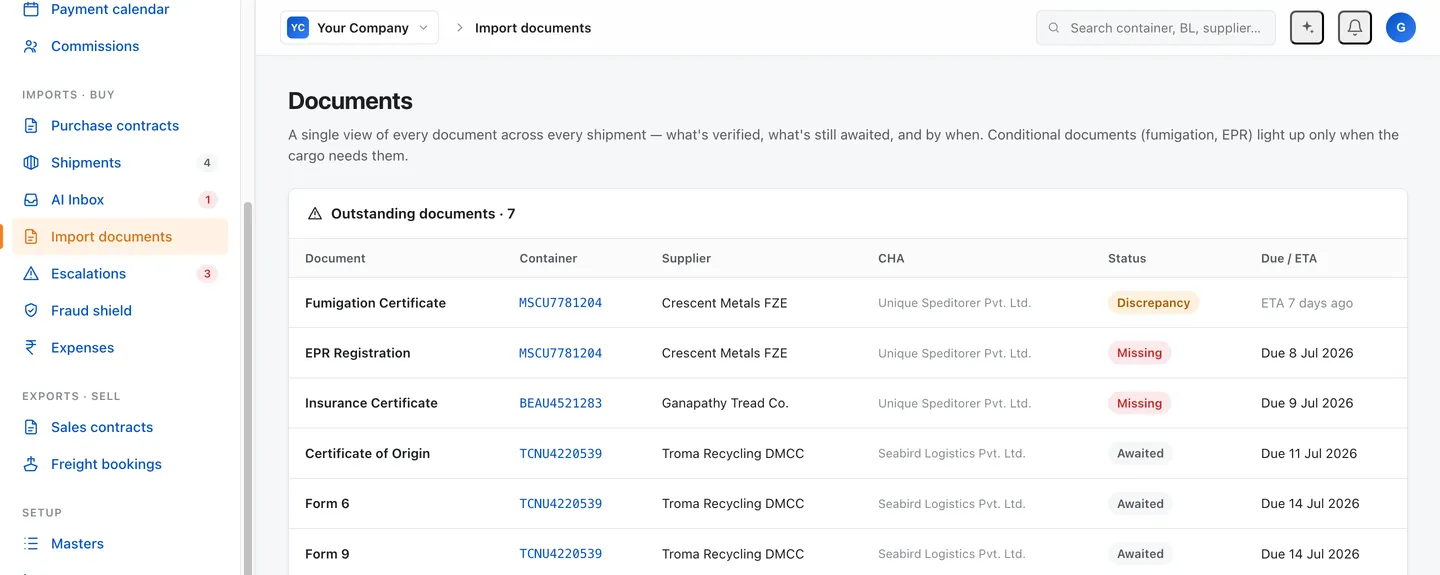
The numbers are the ones every import desk already lives with. On an ordinary desk the document pack runs about eight days behind port free time before any bank is involved, and a week of demurrage on one container has cost US$12,000. A letter of credit refused on a curable discrepancy adds a re-presentation cycle on top of that: the corrected document has to be produced, couriered, and examined again, and free time does not wait. This is why import document checking software that reads the whole pack against the credit before it is presented is not a banking nicety. It is the difference between catching a conflicting date at the desk and discovering it in a refusal notice five days after the goods landed.
The discrepancies that recur
The families are consistent across desks and they are the ones ISBP 745 spends its length on:
- Transport documents. A bill of lading not marked shipped on board, missing a required endorsement, or showing a description the credit did not permit.
- The commercial invoice. A goods description that does not match the credit word for word, an amount over the credit value, or a figure that disagrees with the packing list.
- Insurance. A cover note dated after the shipment date, or for less than the percentage the credit required.
- Dates. A presentation after the credit’s expiry, or after its latest shipment date. This is the family that cannot be cured by re-presenting, because the date has already passed.
The first three are correctable while the credit is still open. The fourth is why the credit’s own deadlines belong on the desk’s calendar and not only in the bank’s file. The expiry date and the latest shipment date are contract terms, the same way a payment due date is, and payment calendar automation that reads them off the credit puts them in front of the desk before they arrive rather than after.
What the desk can do about it
A discrepancy discovered before presentation is a correction. The same discrepancy discovered after is a negotiation with the applicant for a waiver, and a waiver is a favour, not a right. Everything useful a desk can do sits before the documents go to the bank:
- Read every document in the pack against the credit, not against the shipment. The bank checks paper against paper, so the desk has to as well.
- Treat the credit’s expiry and latest shipment date as hard deadlines and count backwards from them, the same way a last free day is worked backwards.
- Keep the discrepancy notice when one comes. It is dated, it is complete under Article 16, and it tells you exactly what to fix and how many banking days you have left in the credit to fix it.
None of this makes a bank lenient, because the bank is not the problem. The problem is two documents that disagree, and the only place to catch that cheaply is at the desk, before the five-day clock and the demurrage clock start counting the same delay twice.
Questions this raises
What is a letter of credit discrepancy?
A difference between the documents you present and what the credit asks for. It can be a wrong figure, a description that does not match the invoice, a document missing an endorsement, a date past the latest shipment or expiry, or two documents that disagree with each other. UCP 600 Article 14(d) sets the standard: data need not be identical across the documents, but it must not conflict. Anything that conflicts is a discrepancy the bank can refuse on.
Can a bank refuse to pay a letter of credit over a small discrepancy?
Yes. The bank examines documents on their face, not the value or the intent behind the error. A misspelled consignee, a bill of lading that says 'said to contain' where the credit named the goods, or an insurance amount a percent short is enough to make the presentation non-complying. The size of the mistake does not decide it. Whether the data conflicts with the credit does.
How long does a bank have to reject documents under a letter of credit?
A maximum of five banking days following the day of presentation, under UCP 600 Article 14(b). If the bank refuses, Article 16(c) requires a single notice that lists every discrepancy and says whether the documents are held, returned, or dealt with on your instructions. Article 16(f) is the counterweight: a bank that misses the deadline or splits the notice is precluded from claiming the documents do not comply, and must pay.
What happens to my goods if the letter of credit documents are discrepant?
The goods are unaffected by the discrepancy, and that is the trap. The container is at the port on its own clock. A refusal holds the release documents at the bank while the presentation is corrected or a waiver is sought from the applicant, and free time does not pause for any of it. On an ordinary import desk the pack already runs about eight days behind free time, and a week of demurrage on one container has cost US$12,000, so a document held for a re-presentation is a charge accruing in the background.
What are the most common letter of credit discrepancies?
The recurring families are transport documents, the commercial invoice, insurance, and dates. In practice: a description on the invoice that does not match the credit word for word, a bill of lading not marked on board or missing an endorsement, an insurance cover note dated after the shipment or short of the required percentage, a presentation after the credit's expiry or latest shipment date, and figures that disagree between two documents in the same set. Most are avoidable by reading the pack against the credit before it goes to the bank.
Can a discrepancy be fixed?
Sometimes, and the clock decides whether it matters. If the credit has not expired and the latest shipment date has not passed, a corrected document can be re-presented. If the discrepancy is a date that has already gone by, it cannot be cured by re-presenting, and payment depends on the applicant agreeing to waive it. That waiver is a favour, not a right, which is why a discrepancy discovered before presentation is worth far more than one discovered after.
Sources
- ICC Uniform Customs and Practice for Documentary Credits, UCP 600 (ICC Publication 600, 2007 revision): Article 14(b) — a maximum of five banking days following the day of presentation to determine compliance; Article 14(d) — data need not be identical to, but must not conflict with, the credit or any other stipulated document; Article 16(c) — a single notice stating each discrepancy and the disposition of the documents; Article 16(f) — a bank that fails to act in accordance with Article 16 is precluded from claiming the presentation does not comply
- ICC International Standard Banking Practice for the Examination of Documents under UCP 600, ISBP 745 (ICC Publication 745, 2013)
- ICC Academy, ISBP Insights: Avoiding common LC discrepancies — 'a significant number of presentations under letters of credit are found to contain discrepancies' · checked 2026-09-22
- Docket operational baseline, import–export desk: paperwork runs about eight days behind port free time; a week of demurrage on one container has cost US$12,000